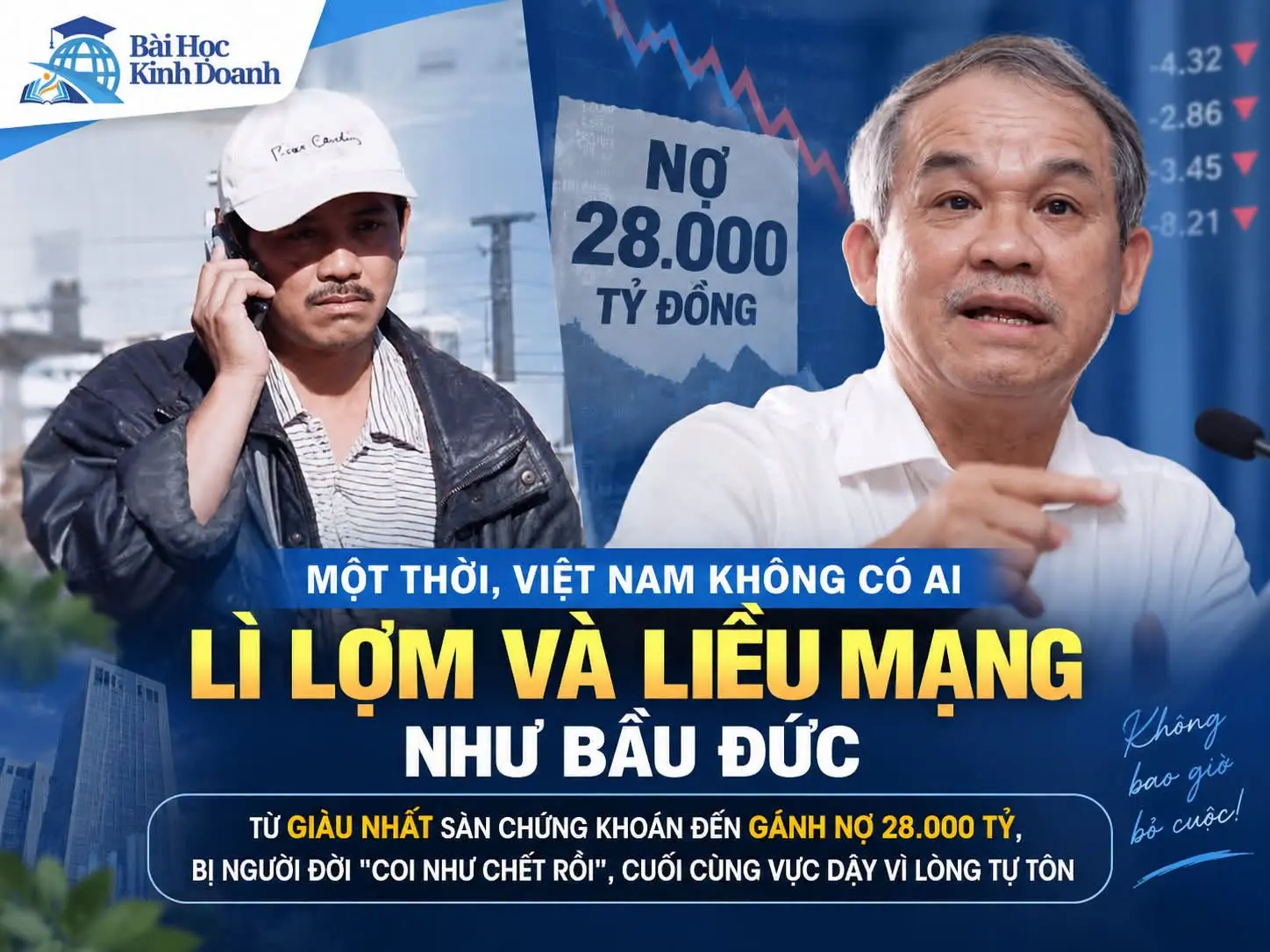
Once at the top of Vietnam’s stock-market rich list, Đoàn Nguyên Đức later had to lead Hoàng Anh Gia Lai through a liquidity crisis with total liabilities once exceeding VND 36,000 billion, including approximately VND 28,000 billion in borrowings. Nearly a decade of asset sales, creditor negotiations, sector retrenchment and a return to agriculture brought the business to a different position. In 2026, HAGL entered a new phase with agricultural expansion plans and the HGI IPO. This is not a rosy comeback story, but a case study in survival, cash flow, disciplined downsizing and the price of growing too quickly.
1. Thinking big creates advantages, but also magnifies mistakes
Once Vietnam’s wealthiest listed-company investor, Đoàn Nguyên Đức occupied a position many entrepreneurs dream of. But the journey’s greatest value lies not in the wealth ranking. It lies in the long path from rapid expansion to illiquidity, selling assets that once built the company’s name and persistently rebuilding a cash-generating model.
Hoàng Anh Gia Lai began in 1992 as a woodworking enterprise with only tens of millions of dong in initial capital, according to Đức. It quickly expanded timber exports, entered property and built capabilities from materials to construction. During the property boom, early land acquisition and control of the value chain helped HAGL move faster than competitors. In 2009 alone, four major projects generated over VND 3,300 billion, approximately 77% of group revenue, according to figures Đức gave in a July 2026 interview.
Thinking big is not inherently a problem. It creates leadership when a business is right about cycles, costs and demand. The same philosophy magnifies losses when core assumptions are wrong. Larger projects, loans and fixed costs leave less time to correct mistakes. Ambition therefore needs a safety margin: debt limits, investment stopping points and below-expectation revenue scenarios.
2. Exiting at the peak does not guarantee the next pivot is right
Đức says HAGL began aggressively selling property projects in 2012 after recognizing speculation-driven housing prices. This was a notable exit from a cycle. Capital subsequently moved into long-term agricultural projects such as rubber and oil palm amid high commodity prices. By the time much of the rubber acreage was ready for harvesting, international prices had fallen sharply from the investment-planning period.
This case shows that one correct decision does not offset the next decision’s risks. A founder can recognize a bubble in the old sector yet overestimate forecasting ability in the new one. Projects dependent on commodity prices, weather and multiyear establishment periods need scenarios for deep price declines, low yields, rising capital costs and delayed harvesting.
3. Large assets do not mean available cash
By 2016, sources citing company leadership recorded HAGL’s total debt above VND 36,000 billion, with annual interest expenses around VND 4,000–5,000 billion. Investments such as rubber, hydropower and farmland were long-term assets that did not generate sufficient cash at the required time. HAGL became illiquid despite holding a very large asset base.
This is the vital difference between profitability on paper and payment capacity in practice. Businesses do not fail simply because expected profit is lacking; they often fall first because cash is unavailable when obligations are due. Management reports should place collection schedules, debt repayments and asset-sale feasibility beside revenue, profit and total assets.
4. In a liquidity crisis, a business needs one overriding priority
During nearly a decade of restructuring, HAGL sold or transferred many assets and businesses, including assets once considered difficult to sell, such as a hospital. It reduced non-core investment, negotiated with creditors, exchanged debt for equity and sought cash flow from short-cycle agriculture. Đức repeatedly described the overriding goal as reducing debt rather than borrowing more to prolong the imbalance.
Restructuring is not an inspirational slogan. It forces founders to accept smaller scale, lost assets, ownership dilution and abandoning projects tied to their reputation. In a crisis, businesses should identify a survival measure, typically cash and upcoming obligations, then judge every decision by its ability to improve that measure.
5. Reputation and partners are forms of capital in a crisis
HAGL’s turning point did not come only from asset sales. Its 2018 agreement with THACO provided agricultural resources and time to address finances. In subsequent years, it continued working with banks, debt-trading companies and investors to restructure bonds, settle or exchange debt obligations. Some employees also stayed through wage difficulties.
When the balance sheet is no longer persuasive, trust in leadership, transparency and a history of honoring commitments may determine whether partners grant more time. Reputation does not replace contracts or a financial plan, however. It opens negotiations; the business must still demonstrate clear assets, cash flow and risk-sharing arrangements.
6. Short-term cash flow must support long-term strategy
During rebuilding, bananas generated cash earlier than long-cycle crops. Bananas failing export standards were used as animal feed, creating another value cycle instead of complete disposal. HAGL subsequently developed durian, coffee, mulberries and livestock, aiming for several pillars rather than betting on one crop as in the rubber period.
Using short-term activities to fund long-term plans works only if the short-term business generates cash after operating costs, logistics and working capital. Diversification does not mean entering numerous sectors. Pillars should share land, infrastructure, customers or by-products to reduce overall costs and risks; otherwise the business merely returns to a difficult-to-control conglomerate under a new name.
7. Record profit does not mark the end of restructuring
According to fourth-quarter 2025 consolidated financial statements summarized by VnExpress, HAGL recorded VND 7,440 billion in net revenue and VND 2,243 billion in after-tax profit for 2025, its highest-ever profit. However, this coincided with lower financing costs and the issuance of 210 million shares to exchange over VND 2,500 billion in bond debt, so operational improvements must be separated from financial restructuring effects.
Entering 2026, Đức considered HAGL to have completed the essential part of restructuring. This needs careful interpretation: the parent may have substantially reduced financial debt, but subsidiaries still need production borrowing, and consolidated reports still reflect other obligations. Passing the survival-threatening phase does not mean every cash-flow, debt or agricultural-price risk has disappeared.
A sign of the new phase is HGI, which manages HAGL’s agricultural projects in Laos and which Đức calls a “golden goose,” receiving approval for an initial public offering. The planned IPO would issue up to 18.8 million shares to fund growing-area expansion and financial restructuring. As of the article’s September 9, 2026 update, the offering was still under way and Bài Học Kinh Doanh had not confirmed its final outcome from official disclosures.
For business owners, one highly profitable year or an IPO plan is not a certificate that restructuring is complete. It should be a time to strengthen the balance sheet, control investment pace and demonstrate core operating cash flow. The memorable lesson is not how wealthy an entrepreneur once was, but the willingness to become smaller so the business survives long enough to rejoin the race.
- Leveraged growth is safe only when cash arrives before debt payments and can withstand adverse scenarios
- A business with many assets can still lose liquidity if long-term assets do not generate cash at the right time
- Successful restructuring requires decisive retrenchment, sufficiently strong partners and a core model producing real cash flow
Ambition was not HAGL’s mistake; the problem arose when financial commitments grew faster than its ability to absorb shocks. The lesson is to build two capabilities together: courage to expand when opportunities arise and discipline to reduce scale before the market forces it.
Suggested actions
Sources and updates
Originally prepared by the Bài Học Kinh Doanh editorial team on August 31, 2026 and updated September 9, 2026 using Hoàng Anh Gia Lai reports and disclosures and the press sources below. Over VND 36,000 billion refers to total liabilities at the peak, while approximately VND 28,000 billion refers to borrowings cited by multiple sources; they are not interchangeable. The assessment that HAGL resolved its debt bottleneck is Đoàn Nguyên Đức’s view and does not mean the group has no remaining debt obligations. HGI IPO plans, cultivated areas and future profits are company disclosures, not guaranteed results. The supplied illustration’s figures do not replace financial reports. This is not a securities investment recommendation.

Bài Học Kinh Doanh Editorial Team
Editorial Team | Bài Học Kinh DoanhBan Biên tập Bài Học Kinh Doanh tổng hợp và biên tập các nội dung về kinh doanh, thị trường, quản trị, công nghệ và khởi nghiệp, với mục tiêu giúp người đọc hiểu rõ vấn đề, nhìn thấy bài học phía sau dữ kiện và có thêm cơ sở cho các quyết định thực tế.
View author profile