Robots have appeared in refueling and trials for shop and warehouse operations at Chinese fuel stations. A business perspective must go beyond 'robots replace staff': identify suitable tasks, measure cost per completed outcome, check reliability and design human takeover roles. These examples do not establish fully unmanned fuel stations or large-scale economic performance.
Robots have begun 'working shifts'—but on which tasks?
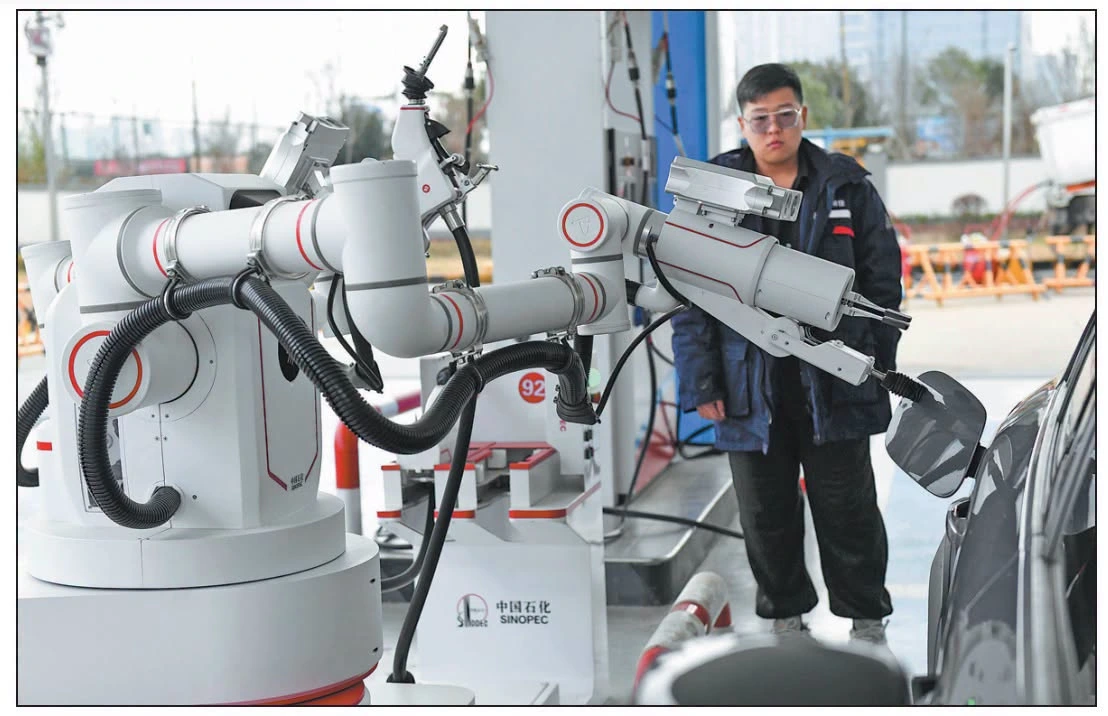
On April 1, 2026, China Daily published an image of a refueling robot closing a car's fuel cap at a station in Changsha, Hunan. Taken by Yang Huafeng of China News Service, the photo accompanied an article on AI in China's energy sector. This is the publication date, not a confirmed robot operating-start date.
In a separate application, CNPC's China Petroleum Daily reported on July 27, 2026 that its Shanghai business unit and partners introduced robots for fuel-station trials supporting a convenience-store and nearby-warehouse model. The source calls them embodied-intelligence robots: systems connecting environmental perception with physical action.
Both reports show automation reaching several stages at energy retail outlets. Distinguish robots working on cars from those supporting shops and warehouses. The sources do not establish a completely unmanned station, replacement of all employees or mass deployment.
1. The first unit of automation is a task
A fuel-station shift involves more than holding a nozzle. Staff direct vehicles, confirm requests, assist payment, monitor the site, handle incidents and answer customers. Automating one action does not equal performing an entire job.
Operationally, trial candidates often have high frequency, relatively clear inputs, repeatable execution and checkable outcomes. Repetition is only a starting condition. Businesses must also assess real-world variations, safety requirements and human takeover when machines fail to finish.
The management lesson is how to frame the question. Instead of starting with 'Which robot should we buy?', list shift tasks, execution times, error frequency and handling costs. Only after identifying what slows the system can you choose what to automate.
2. One successful action does not prove full-shift performance
An image of a robot completing an action visually demonstrates an application. Scaling needs different evidence: reliable operation across multiple shifts under conditions and cases the outlet actually encounters.
For automated refueling, questions include supported vehicles, parking requirements, out-of-scope detection and staff takeover time. These assess implementation; they are not confirmed features of the robot pictured.
Measure both completion without assistance and intervention time when errors occur. A machine quick in most cases can still create queues if exceptions take too long. System quality includes normal flows and exception handling.
3. Economic performance must be calculated per completed service
Purchase price is only part of the calculation. Total costs include integration, site modifications, training, maintenance, software, energy, supervision and operations during downtime. Comparing equipment price only with one employee's salary misses costs determining actual performance.
A useful metric is cost per completed service. Divide operating costs plus allocated investment costs for a period by satisfactory completed services in the same period. The denominator must reflect real outcomes, not how often a robot starts.
For cash flow, distinguish actual cash savings from freed time. If staff still work full shifts but move to customer service or selling, the benefit does not automatically reduce payroll. Measure whether that time improves service, contribution profit or specific costs.
Do not assume robots increase revenue. If the bottleneck is low footfall, inaccessible premises or slow payments, automating pumping may solve the wrong issue. Cited sources lack enough data to calculate savings or payback for these two cases.
4. The story extends to retail and delivery
Shanghai's application is notable for combining a convenience store with a warehouse serving nearby demand. A nearby or front warehouse emphasizes positioning goods close to consumption areas for faster order fulfillment.
From Bài Học Kinh Doanh's perspective, this suggests a site serving walk-in customers while fulfilling orders from other channels. This is business-model analysis, not a claim that Shanghai's robots perform all those stages.
For businesses pursuing this approach, inventory data must be accurate, goods locations clear and shortage responsibilities agreed. Automated movement or picking creates value only when order information, actual stock and handoff processes align.
5. Human roles change, but transition needs a plan
As machines perform more repetitive tasks, people may shift toward monitoring, exceptions, safety and customer support. 'May' matters: this depends on shift design, training and responsibilities.
An employee accustomed to hands-on work does not automatically become a system supervisor. They need to understand error alerts, operating limits, stopping conditions and support procedures. Do not assign too many machines to one supervisor just because normal operation appears smooth.
Over time, job numbers and composition may change with deployment scale. These two cases do not establish how many people were replaced. Workers should prepare process-reading, system-use and problem-solving skills alongside the transition.
6. Safety and takeover must be designed in
Fuel stations are settings where operating failures can have serious consequences. Efficiency assessment must include equipment- and site-appropriate safety appraisal. Implementation needs professional assessment; another site's robot presence is not proof of safety.
Clarify who can stop the system, receives alerts, activates backups and handles incidents. Operating data must also allow reconstruction of events and process improvement.
Good automation makes accountability clearer. If customers encounter trouble without knowing whom to call, or staff do not know when to intervene, the business is shifting technology's complexity onto users.
7. Vietnamese businesses should start with one specific bottleneck
The immediately applicable lesson is organizing work before choosing equipment. A shop might begin with stock reconciliation; an e-commerce business with order printing, sorting or packing checks. Not every task needs a physical robot; simpler options deserve priority when they solve the problem well.
A trial should be small but representative: measure current practice, select a task, define success and prepare a return to the old process. Then compare quality, time, cost and human intervention. Scale when operating data shows consistent benefit, not merely after a favorable demonstration.
Robots 'working shifts' at fuel stations are memorable. The deeper lesson is standardization: the better businesses understand tasks, data and exceptions, the stronger their basis for applying technology correctly. Advantage belongs not merely to early machine buyers but to those turning technology into better, measurable service.
- Distinguish the Changsha refueling application from Shanghai's shop and warehouse robot trials.
- Assess performance using full-shift data, total costs and the rate of human assistance.
- Standardized processes, staff training and takeover design are foundations before scaling.
Automation advantage begins with understanding the work to improve. Technology creates value when it solves a specific bottleneck, works reliably in practice and produces measurable outcomes for customers and the business.
Suggested actions
Sources and updates
Cross-checked against China Daily on April 1, 2026 and CNPC's China Petroleum Daily on July 27, 2026. These confirm separate applications and trials but provide insufficient total-cost, payback or labor-replacement data. Operating economics, staffing and implementation sections are Bài Học Kinh Doanh analysis, not measured results at the two sites. Image credit: Yang Huafeng/China News Service, via China Daily.
Last updated: 26 Sept 2026
Bài Học Kinh Doanh Editorial Team
Editorial Team | Bài Học Kinh DoanhBan Biên tập Bài Học Kinh Doanh tổng hợp và biên tập các nội dung về kinh doanh, thị trường, quản trị, công nghệ và khởi nghiệp, với mục tiêu giúp người đọc hiểu rõ vấn đề, nhìn thấy bài học phía sau dữ kiện và có thêm cơ sở cho các quyết định thực tế.
View author profile