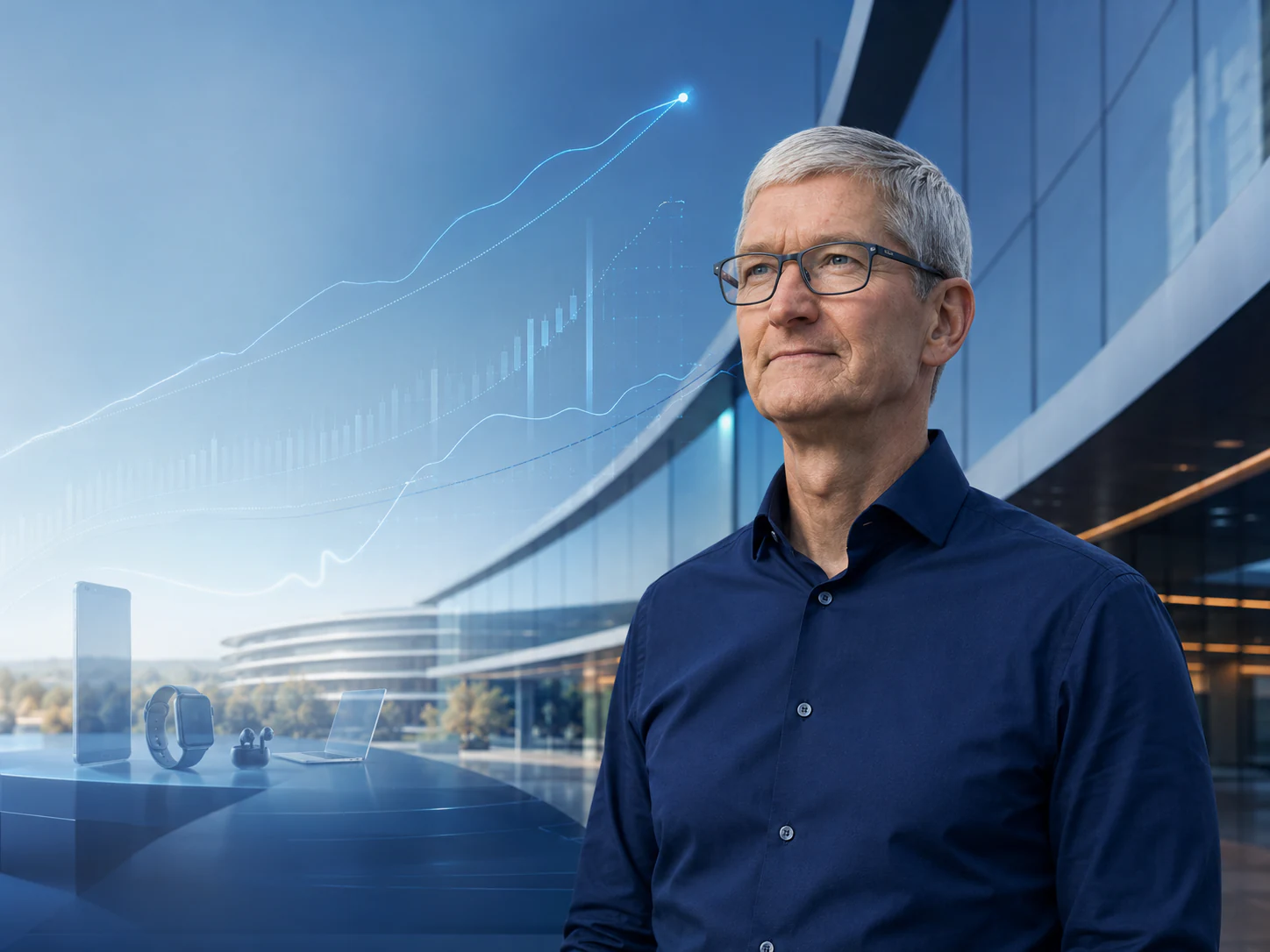
Tim Cook took over Apple on August 24, 2011 under Steve Jobs' enormous shadow and ended his CEO tenure after 15 years. He did not try to become a second Steve Jobs. Instead, Cook turned operations, supply chains, capital allocation and ecosystem monetization into competitive advantages on an unprecedented scale. Apple's revenue nearly quadrupled, services became a machine generating over USD 100 billion annually and active devices exceeded 2.5 billion. But his successor also inherits difficult questions involving AI, regulation, supply chains and the ability to create the next era-defining product.
Not becoming a second Steve Jobs
On August 24, 2011, Tim Cook became CEO after Steve Jobs resigned. The challenge was more than running a rapidly growing technology group. Cook had to succeed a founder whose influence was almost inseparable from the Apple brand itself.
He chose a different path. Rather than reproduce Jobs' presentation style and product intuition, Cook used the capabilities that established his reputation as Chief Operating Officer: supply-chain discipline, inventory management, scaling and turning major decisions into a reliably executable system.
After 15 years, debate over Apple's creativity continues. But financial results show that Cook solved an exceptionally difficult succession challenge: maintaining the appeal of core assets while changing how the business creates and captures their value.
From USD 108 billion to over USD 416 billion in revenue
In fiscal 2011, Apple recorded approximately USD 108.2 billion in revenue and USD 25.9 billion in net income. By fiscal 2025, revenue reached USD 416.2 billion, nearly 3.85 times higher; net income was about USD 112 billion, over four times the level at the start of his tenure.
This growth did not come from replacing the iPhone. Instead, Cook extended the commercial life of Apple's most important product, expanding price segments, markets and associated services. iPhone revenue rose from around USD 47 billion in 2011 to over USD 209 billion in fiscal 2025 and still represented roughly half of total revenue.
What matters is not only that Apple sold more devices. It increased value captured per customer through an ecosystem in which phones, computers, watches, headphones, payments, storage and content work seamlessly together.
From around USD 350 billion to the USD 4 trillion company club
When Cook took over, Apple's market capitalization was around USD 350 billion. During his tenure, Apple became the first US company to reach USD 1 trillion in 2018, USD 2 trillion in 2020 and USD 3 trillion afterward. By the 2026 transition, market value fluctuated above USD 4 trillion.
Cook also changed Apple's relationship with shareholders. The company restored dividends in 2012 and launched a very large share-repurchase program. According to the Financial Times' compilation, total capital returned to shareholders during this period exceeded USD 1 trillion.
Buybacks do not create new products, but signal a change in Apple's lifecycle. It was no longer merely a growth company driven by breakthrough launches; Apple became a cash-generating machine large enough to invest and return shareholder capital at a rarely seen scale.
A services engine generating over USD 100 billion annually
If one change bears Cook's clearest imprint, it may be turning services from a supporting component into a business pillar. Services revenue rose from around USD 9.4 billion in 2011 to over USD 109 billion in fiscal 2025.
Apple Pay, Apple Music, TV+, Arcade, Fitness+, iCloud+ and advertising create more touchpoints across the customer lifecycle. By 2026, Apple reported over 2.5 billion active devices and around 1.5 billion paid subscriptions across services on its platform.
The advantage of services is recurrence. A phone produces recognized revenue when sold, while storage, content and apps can generate revenue for years. The ecosystem therefore increases customer lifetime value while making switching platforms more costly.
Apple Watch, AirPods and the shift to self-designed chips
The Cook era did not lack new products. Apple Watch took the company deeper into health and wearables; AirPods became one of the market's most successful accessory lines. Apple Pay expanded the iPhone's payments role, while Vision Pro expressed ambitions for a spatial-computing platform.
The most consequential long-term decision may be Apple Silicon. Switching Macs from Intel chips to Apple's M-series designs gave greater control over performance, power consumption and hardware–software integration. It clearly illustrates Cook making a major bet through a controlled roadmap.
Yet no Cook-era product has changed mass behavior on an iPhone-equivalent scale. Vision Pro has impressive technology but a high price and narrow market. The electric-car project was canceled after years of investment. That is why Apple's operational success remains accompanied by questions about its next product leap.
Four challenges for the successor
First is artificial intelligence. While competitors rapidly put generative AI at the center of strategy, Apple has been seen as slower than expected. Siri and Apple Intelligence delays have prevented its hardware–software integration advantage from becoming a sufficiently compelling AI story.
Second is regulation. App Store control creates revenue and protects experience, but brings antitrust investigations, demands to open payment systems and fines in multiple markets. Third is supply chains. Cook built an exceptionally efficient manufacturing machine, yet dependence on China remains a major geopolitical risk despite rising production in India and Vietnam.
Finally, scale. With revenue above USD 400 billion, even a highly successful new product may not significantly affect the whole group. The successor needs more than a good product: a market large enough to become Apple's next growth engine.
Business lessons from Tim Cook's 15 years
Cook's legacy shows that succession is not a competition to imitate the founder. A leader can preserve product philosophy while changing operations, distribution, pricing and recurring revenue generation.
The second lesson is that good products alone do not create an ecosystem. Businesses must connect products, data, services and experiences so value grows over time. When each new product makes existing products more useful, growth depends less entirely on a single sale.
Operational effectiveness also has limits. Optimizing a current engine can produce 15 extraordinary years of growth, but the business must still invest in the next engine. This is the boundary between a legacy proven by numbers and a future Apple must continue proving through products.
- Apple revenue rose from USD 108.2 billion in fiscal 2011 to USD 416.2 billion in 2025
- Services revenue grew from approximately USD 9.4 billion to over USD 109 billion, generating recurring revenue and strengthening the ecosystem
- Tim Cook's legacy is not only financial growth but also how an executive succeeds a founder through distinctive capabilities of his own
The greatest lesson from Tim Cook is not that every business needs an operator instead of an innovator. It is that successors need not copy their predecessors' style. They must understand the core assets inherited, protect what should not change and build a growth engine suited to their own capabilities.
Suggested actions
Sources and updates
Edited by the Bài Học Kinh Doanh editorial team on September 1, 2026 from Apple's annual reports and investor materials, SEC filings and international reporting on the leadership transition. Market capitalization and share prices vary with markets; revenue figures use fiscal 2011 and 2025 for complete, comparable reporting periods. Illustrations were originally created for the article and are not Apple archival photographs.
Last updated: 1 Sept 2026
Bài Học Kinh Doanh Editorial Team
Editorial Team | Bài Học Kinh DoanhBan Biên tập Bài Học Kinh Doanh tổng hợp và biên tập các nội dung về kinh doanh, thị trường, quản trị, công nghệ và khởi nghiệp, với mục tiêu giúp người đọc hiểu rõ vấn đề, nhìn thấy bài học phía sau dữ kiện và có thêm cơ sở cho các quyết định thực tế.
View author profile