Owned channels can reduce seller dependence, but the advantage appears only when acquisition, operations and retention costs are lower than the value generated. This analysis distinguishes discount offers from marketplace fees, examines policies and offers a measurable experiment.
1. What does the card inside the parcel reveal?
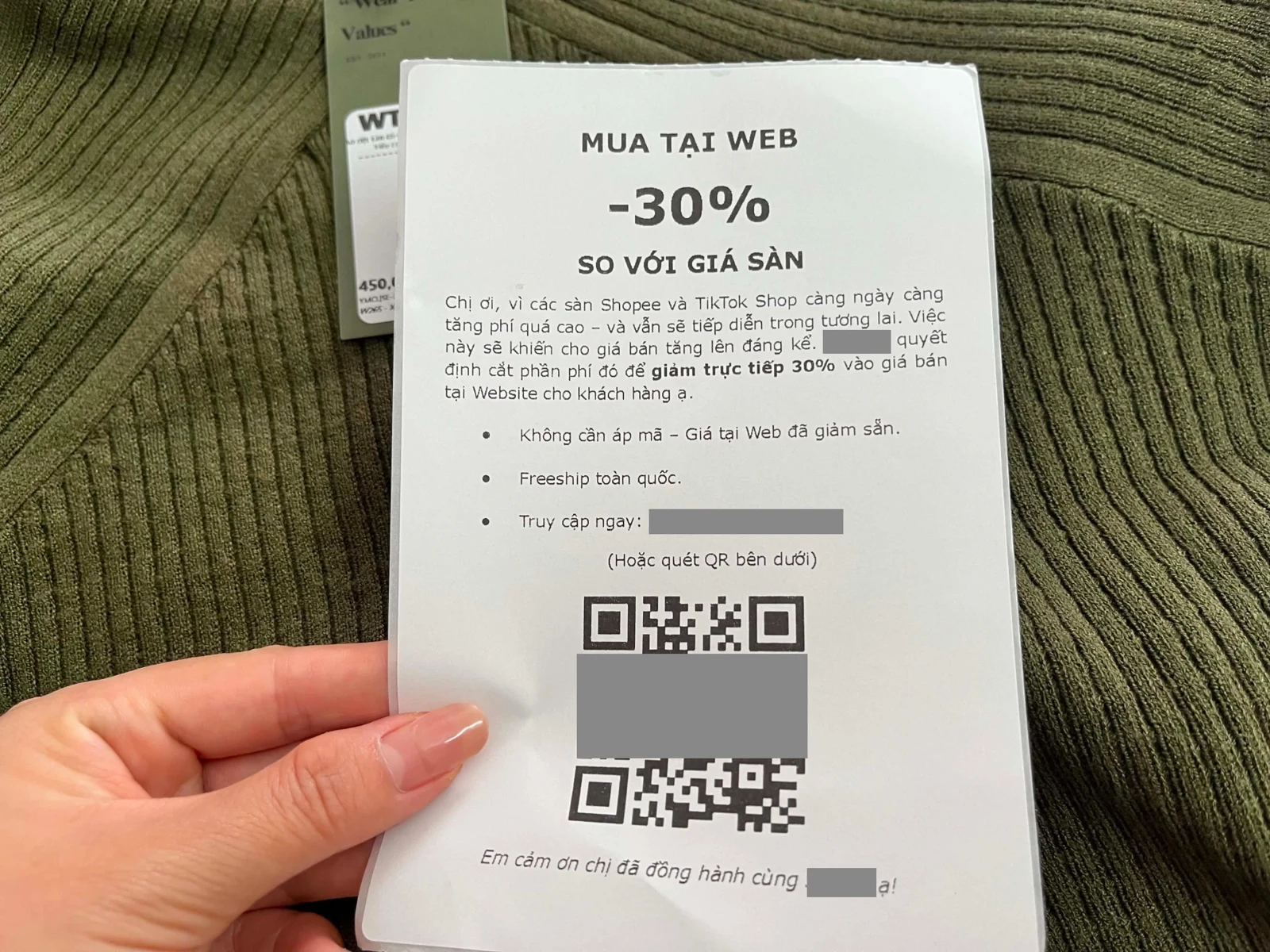
On October 6, VnExpress reported some sellers inviting customers to buy through websites, Zalo or stores for incentives. In one case, a card promised web prices 30% below marketplace prices. These are observations of particular cases, not a representative market-wide survey.
The image supplied with this article carries a similar message. The figure on the card describes a seller’s offer. It does not prove Shopee, TikTok Shop and Lazada all charge 30% fees, nor establish whether the product, conditions and total checkout costs are entirely comparable.
From a business perspective, this response reflects familiar pressure: companies want more control when one channel accounts for a large share of revenue. Sellers may receive many orders but struggle to predict what remains after advertising, promotions, returns and operations. Owned channels then become an urgent question.
There are, however, three different choices: leaving the platform, retaining it while adding independent channels, or adjusting the product range and platform operations. Effectiveness depends on products, customers and capabilities. A brand with its own community starts differently from a store mainly discovered through marketplace search.
The problem to solve is dependence and profit quality. Moving all revenue to another social account may merely change the source of dependence. Long-term value lies in the brand, experience, processes and customer sources the business can sustain.
2. Marketplace fees are only part of selling costs
To compare channels, start with a completed order. Reconcile actual receipts with product cost, seller-funded promotions, advertising, affiliate marketing, packing, shipping, payments and return handling. Using ordered revenue before cancellations as the denominator can make cost ratios look better than reality.
Check platform fee schedules by category, store type, program and date. TikTok Shop guidance shows various additional charges and programs; sellers should compare actual costs in Seller Center. Do not treat one store’s experience as a fee schedule for every product.
Owned channels return some work to the business. Websites need visitors, orders need confirmation, customers need support and payment and delivery need integration. Each may cost money, time or staff. Posting a link does not create buying demand by itself.
An easily forgotten cost is the owner’s labor. If the owner answers messages late into the night and handles each order, cash records may show savings while operations remain hard to scale. Record service minutes per order, contact attempts and complaints, then consider resource needs as orders increase.
Do not double-count charges already deducted from settlement amounts. Keep the same recognition rules across channels and track orders with transaction IDs. The most useful spreadsheet lets its owner trace every line back to documents or reports.
| Cost layer | Marketplace | Owned channel |
|---|---|---|
| Customer acquisition | Advertising, content and affiliate marketing | Advertising, content, referrals and community-building time |
| Order fulfillment | Platform charges, packing and delivery under applicable programs | Payments, delivery, technology and staffing |
| Keeping promises | Cancellations, returns, exchanges and support | Cancellations, returns, exchanges and support organized by the store |
| System maintenance | Store management, inventory and compliance | Website, data, inventory, processes and compliance |

3. Customers buy reassurance, not just a lower price
For buyers, changing where they transact also changes who is responsible when something goes wrong. They need to know whether goods match descriptions, when they will arrive, who handles returns and how refunds work. A discount may not offset uncertainty about an unfamiliar store.
Compare the total amount payable and transaction conditions: are capacity and version identical, how much is delivery, what is the returns window and is payment convenient? Comparing a marketplace list price with a web price excluding shipping leads to misleading conclusions.
Owned channels need verifiable trust signals: consistent descriptions, clear contacts, understandable returns policies, trackable order progress and timely replies. Promises such as immediate delivery or lifetime warranties must reflect delivery capability, defined scope and specific conditions.
Not every customer wants a conversation to place an order. Some prefer choosing, paying and checking an order within minutes. If an owned channel requires asking prices, waiting for stock confirmation and multistep bank transfers, time and effort may eliminate the discount’s benefit.
Platforms also deserve a fair assessment. Customer access, transaction tools and integrated buying experiences all have value. Assess high costs alongside results rather than assuming all fees can be removed without losing anything.
Read nextPractice: optimize product pages to help customers choose
4. Lower fees but excessive discounts can reduce profit
Consider a hypothetical example using the same product with a cost of VND 180,000. Total variable costs for a marketplace order are VND 80,000, versus VND 55,000 for an owned channel. These hypothetical figures combine acquisition and fulfillment costs; they are not published Shopee, TikTok Shop or Lazada commissions.
At a VND 300,000 price, contributions are VND 40,000 and VND 65,000 respectively. But if the store lowers the owned-channel price to VND 270,000, only VND 35,000 remains. Saving VND 25,000 in costs while reducing revenue by VND 30,000 lowers contribution by VND 5,000.
Contribution = net order revenue − product cost − variable costs. Net revenue here deducts seller-funded discounts. Fixed costs, taxes, interest and other adjustments are excluded, so these figures are not net profit. Returned orders require corresponding updates to actual revenue and costs.
Results are particularly sensitive to acquisition cost. If the owned channel needs another VND 15,000 in advertising per order, with other variables unchanged, a VND 270,000 order contributes only VND 20,000. Test a range of costs rather than trusting the best-looking value.
Repeat purchases may reduce advertising needs, but do not assume subsequent orders are free. Content, care, incentives and operations still require resources. Compare customer cohorts over the same period, distinguish first and repeat purchases and check total contribution after retention costs.
A new channel may receive orders that would otherwise occur on the old one. That is revenue migration, not necessarily growth. To assess incremental value, track the business’s total results and customer sources, avoiding counting the same customer in two success reports.
| Scenario | Net revenue | Product cost | Other variable costs | Contribution |
|---|---|---|---|---|
| Marketplace | 300,000 | 180,000 | 80,000 | 40,000 |
| Owned channel, unchanged price | 300,000 | 180,000 | 55,000 | 65,000 |
| Owned channel, 10% discount | 270,000 | 180,000 | 55,000 | 35,000 |

5. Policies and data: having customers does not authorize every use of their information
According to responses cited by VnExpress, Shopee distinguishes thank-you or warranty cards bearing phone numbers from advertising that solicits off-platform transactions. In the same report, TikTok Shop said it did not prohibit cards introducing other channels but recommended against them.
Meanwhile, TikTok Shop’s public customer communication policy dated July 1, 2026 includes notes inside parcels in its scope, restricting off-platform redirection and unauthorized contacts, links or QR codes. These two statements differ in scope and need clarification; the article does not conclude that a particular card is permitted. Sellers should obtain written confirmation for their proposed content.
Lazada cannot be assumed to have the same rules as the other platforms. Check the policy version applicable to the store when implementing. Policies can change, and press responses do not replace complete service terms.
Delivery data does not automatically become an advertising list. TikTok Shop’s terms limit data use and require prior, explicit consent for direct marketing where applicable. Consent does not automatically remove other platform restrictions.
Independent customer sources can be built through the brand’s own website and media, events, stores and voluntary referrals. When collecting information, state the purpose, contact scope and opt-out method, and collect only what is necessary. Do not automatically add phone numbers from marketplace orders to marketing groups.
Control must go with trust. Choosing to receive usage instructions does not necessarily mean choosing daily promotions. Separate content subscriptions, transactions and marketing contact choices; maintain easy unsubscribing and controls on who can access data.

6. Choose each channel’s role instead of duplicating everything
In an omnichannel model, every location need not sell the same package with the same message. A business may retain marketplaces for standardized products, use its website for selection guidance and brand experience, and stores for direct consultation. Validate these roles using the business’s own data.
Assess Shopee, TikTok Shop and Lazada separately for discoverability, order quality, returns and contribution. Do not assume one platform is always cheaper or better. A product suited to video content may have different cost economics from one customers actively search for by name.
Bottlenecks often appear when sales span several channels but stock remains in separate spreadsheets. Accepting more orders for the same item than stock allows can trigger cancellations and damage trust across all channels. Before driving traffic, standardize SKUs, available stock, confirmation deadlines and exception owners.
Returns processes also need clarity. Customers should know where transactions are resolved according to their purchase channel and applicable conditions. Support teams need visibility into order status without making buyers repeat their problems. Consistent service quality matters more than identical channel interfaces.
Owners should monitor a common dashboard: completed orders, net revenue, contribution, return rates, handling time and repeat purchases. Product analysis prevents profitable goods from hiding loss-making groups. Channel analysis avoids optimizing one metric while weakening the total system.
| Area | Possible role to test | What to measure |
|---|---|---|
| Marketplace store | Reach demand and complete platform transactions | Contribution after returns, order quality |
| Brand website | Explain products, support selection and sell directly | Acquisition costs, completion rates |
| Physical store or private consultation | Experience and support for complex needs | Service time, value and satisfaction |
| Independent content channel | Create demand and voluntary relationships | Quality reach, subscriptions and repeat purchases |

7. A 30-day experiment: build an owned channel around a measurable problem
In week one, choose a product group with clear information, costs and inventory. Compile completed-order costs and set a specific hypothesis: the owned channel will attract new customers or improve contribution through a better-suited experience. Define the budget and stop conditions in advance.
In week two, complete product pages, checkout, delivery information and returns policies. Check them with a few trial transactions in your own system. Record customer steps and response times. Before increasing traffic, ensure the store can handle orders and post-sale issues.
In week three, distribute content to independent customer sources the brand is permitted to reach. Choose a message about a genuine need: selection, use or product differences. Keep cost and order-source tracking consistent; do not use transferred marketplace order data as the experiment.
In week four, assess completed orders and total contribution. Separate new customers from familiar ones; check cancellations, unfinished returns and unrecorded costs. With limited data, results are signals for further testing, not sufficient proof of long-term effectiveness.
Pre-expansion checklist: an identified customer source; a cost table without double-counting; clear purchase and returns terms; synchronized inventory; purpose-appropriate data collection; policy-compliant content; a complaint owner; a budget cap; and a review schedule.
Thirty days cannot measure a long repeat purchase cycle. For products repurchased only after months, continue tracking cohorts longer. Do not use first-week revenue or visits as evidence of successful retention.
BHKD lesson: an owned sales channel is valuable when it creates and serves demand better with clear economic results. Reduced dependence comes from brand-building, operational capabilities and voluntary relationships. A link is only the beginning of that system.
Read nextKeep tracking: how to calculate repeat purchase rates
- Compare contribution from completed orders, not commission fees alone.
- Buyers need a trustworthy experience before changing where they purchase.
- Build independent customer sources and use data for its stated purpose; check each platform’s conditions.
Reducing dependence means strengthening the ability to create demand, serve customers and retain them. A website becomes a business asset only when customers have a reason to visit and the business can fulfill its promises.
Suggested actions
Frequently asked questions
Is selling through an owned website always cheaper than a marketplace?
No. Add acquisition, payment, delivery, support, returns and technology costs. Compare contribution from completed orders for the same product group, then include fixed costs.
Does a 30% website discount prove marketplace fees are 30%?
No. It is one seller’s price offer. Fees and total costs depend on category, store type, program and date; compare reports and applicable terms.
Can off-platform purchase invitation cards be placed in every parcel?
Do not infer a universal right. TikTok Shop’s report response and public policy need clarification, Shopee distinguishes content types and Lazada’s terms require separate checking. Obtain confirmation for proposed content before implementation.
What should an owned-channel experiment measure?
Measure completed orders, net revenue, contribution, acquisition costs, return rates, service time and repeat purchases by cohort. Check total business results to distinguish incremental gains from shifting orders off the old channel.
Sources and updates
Cross-checked on October 7, 2026. The VnExpress report dated October 6 mainly concerns Shopee and TikTok Shop; Lazada is included in the omnichannel strategy analysis without assuming identical terms. TikTok Shop’s public policies and its response in the news report differ in ways requiring clarification. Shopee and Lazada guidance pages did not provide complete detailed content through this retrieval; the article does not assert specific Lazada penalties or conditions. Calculations, journeys and checklists are original analysis, with hypothetical amounts. The six section illustrations are AI-generated and do not depict actual sellers.

Bài Học Kinh Doanh Editorial Team
Editorial Team | Bài Học Kinh DoanhBan Biên tập Bài Học Kinh Doanh tổng hợp và biên tập các nội dung về kinh doanh, thị trường, quản trị, công nghệ và khởi nghiệp, với mục tiêu giúp người đọc hiểu rõ vấn đề, nhìn thấy bài học phía sau dữ kiện và có thêm cơ sở cho các quyết định thực tế.
View author profile