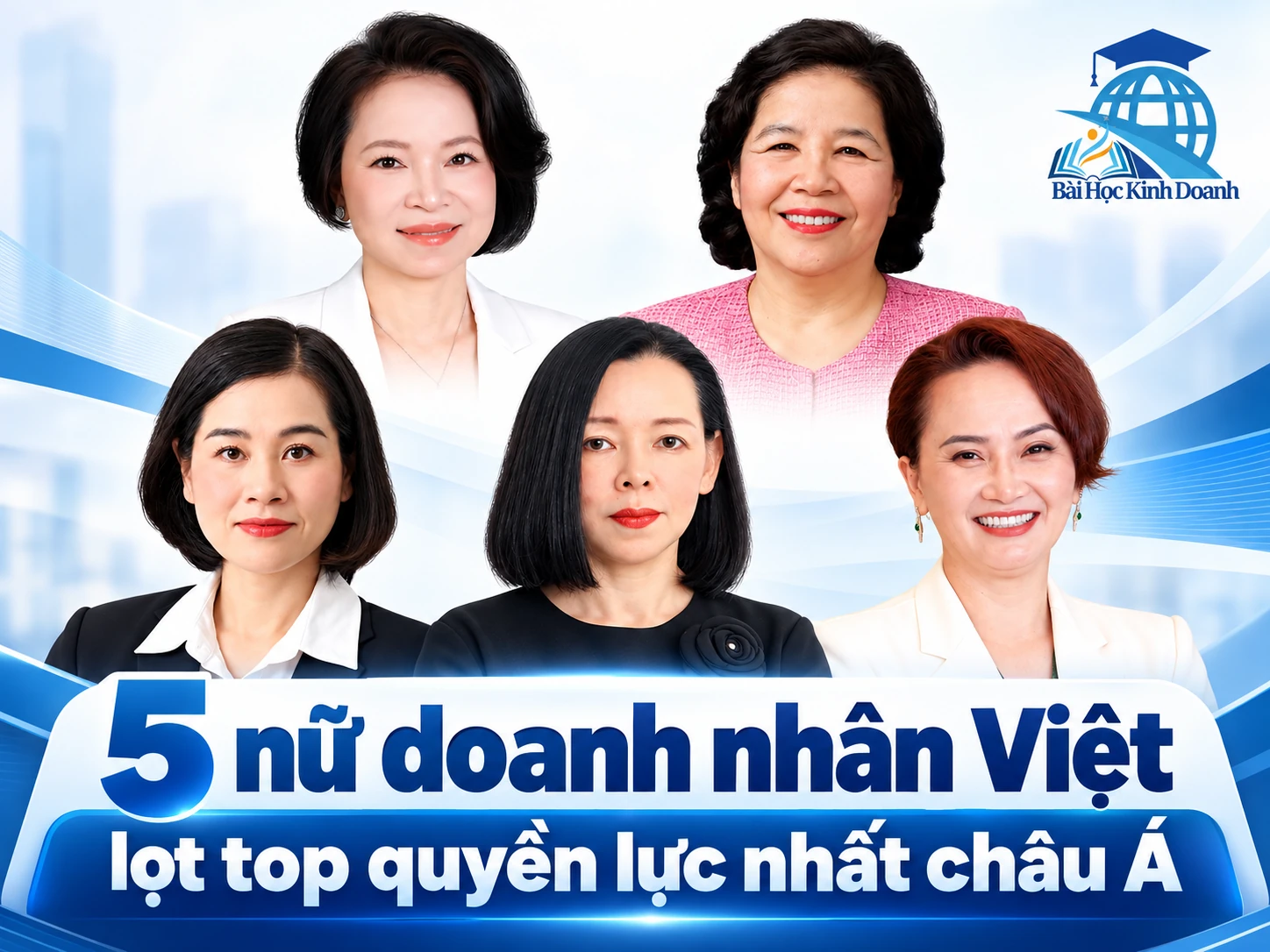
On October 6, 2026, Fortune announced Most Powerful Women Asia 2026, featuring five Vietnamese representatives: Phạm Thu Hương, Mai Kiều Liên, Nguyễn Thị Hoa, Nguyễn Bạch Điệp and Đặng Huỳnh Ức My. Their presence across several sectors offers a perspective on different ways to build influence in business.
Five Vietnamese representatives recognized
According to Fortune's announcement, this year's list includes 100 women leaders from 14 markets. Technology has 16 representatives and banking 14, demonstrating both sectors' influence in the regional business landscape.
Phạm Thu Hương is the highest-ranked Vietnamese representative. The others are associated with dairy, international telecommunications, retail and agriculture. The roles in the table below are those recorded at the announcement date.
| Rank | Woman leader | Position / company |
|---|---|---|
| 37 | Phạm Thu Hương | Vice Chair of Vingroup |
| 71 | Mai Kiều Liên | CEO of Vinamilk |
| 84 | Nguyễn Thị Hoa | CEO of Viettel Global |
| 90 | Nguyễn Bạch Điệp | Chair of FPT Retail |
| 95 | Đặng Huỳnh Ức My | Chair of TTC AgriS and Betrimex |
Phạm Thu Hương: a record of building businesses
Phạm Thu Hương, Vice Chair of Vingroup, made her first appearance at number 37. According to CafeF, she helped build Vingroup alongside Phạm Nhật Vượng, from their business journey in Ukraine to expansion in Vietnam.
From BHKD's perspective, building a conglomerate requires coordinating multiple units, allocating resources and maintaining a shared direction. For a small business, an applicable question is: when adding a new activity, which existing capabilities can support it, and who is accountable for the results? This is an analytical suggestion, not a description of Vingroup's internal processes.
Mai Kiều Liên: a long-term leadership journey
Mai Kiều Liên, CEO of Vinamilk, ranked 71st. CafeF notes that she joined Vinamilk's predecessor in 1976 and began leading the company in 1992.
A long career raises the question of sustaining core foundations while customers and markets change. BHKD believes business owners should distinguish what must be retained, such as quality standards, from what can be adjusted, such as customer outreach. Longevity alone does not ensure competitiveness; an organization still needs to learn and update its capabilities.
Nguyễn Thị Hoa: leadership across multiple markets
Nguyễn Thị Hoa, CEO of Viettel Global, ranked 84th. According to VietTimes, she became CEO in February 2025 after working in investment and telecommunications at Viettel.
From a management perspective, international operations require understanding local contexts, from customer needs to team coordination. BHKD sees a useful question for founders seeking expansion: which parts of the model need to remain consistent, and which should local teams have authority to adjust? Copying every practice from the original market can overlook important differences.
Read nextRead next: understanding markets when taking Vietnamese products globalNguyễn Bạch Điệp: changing the drivers of growth
Nguyễn Bạch Điệp, Chair of FPT Retail, appeared on the list for the first time at number 90. VietTimes highlights her role in developing Long Châu alongside the company's technology retail foundation.
This story prompts BHKD to examine how expansion sectors are selected. An attractive opportunity must be considered alongside customer-service capability, operational organization and implementation resources. For SMEs, entering another product category should start with validating demand and capabilities rather than simply looking at market size.
Đặng Huỳnh Ức My: innovation in a traditional sector
Đặng Huỳnh Ức My, Chair of TTC AgriS and Betrimex, ranked 95th. CafeF reports that she became Chair of TTC AgriS in July 2024; the business is developing toward circular agriculture and technology adoption.
BHKD believes innovation in a traditional industry can start with specific stages: using resources more efficiently, improving quality or increasing operational traceability. Its value must be tested through actual results. A technology project with a new name does not by itself prove that the business model has improved.
How should this ranking be read?
Fortune's announcement identifies assessment factors including company size and performance, career journey, influence, innovation and social impact. Most Powerful Women Asia therefore recognizes business leadership; its ranking should not be interpreted as a personal-wealth list or an assessment of every aspect of a person.
BHKD also notes that corporate results reflect an organization's collective work. Recognition of leaders can draw public attention to a business but does not replace examining its strategy, team and operational results. These five individuals alone also do not support conclusions about the overall state of gender equality in Vietnamese businesses.
The Bài Học Kinh Doanh perspective: from individuals to organizational capabilities
The insight is that influence can be built across many industries and career paths. Business owners can turn interest in the ranking into three practical questions: for whom does the organization create value, what capabilities are difficult to replace, and how can those capabilities keep developing when the leader no longer handles everything personally?
Consider a hypothetical founder who approves every purchasing proposal. Rather than trying to make decisions faster each day, they can establish spending limits, selection standards and verification steps so the team can handle suitable matters independently. Individual capability then begins to become system capability.
For developing women leaders, BHKD suggests examining opportunities to own important tasks, decision authority and transparent assessment mechanisms. Recognition becomes more meaningful when accompanied by conditions that allow capable people to take on challenges and grow. What does your business need to change to create more such opportunities?
Read nextPractice: build a delegation matrix to reduce founder dependence- The five Vietnamese representatives ranked 37th, 71st, 84th, 90th and 95th.
- The list recognizes women leaders' business influence across Asia-Pacific.
- BHKD's perspective focuses on the organizational and innovation capabilities behind the recognition.
A leader's influence should be viewed through their ability to build an organization: make decisions, develop successors and sustain customer value. A ranking marks recognition; operational systems and long-term results are what a business must continue nurturing.
Suggested actions
Frequently asked questions
Who are the five Vietnamese women leaders recognized by Fortune in 2026?
Phạm Thu Hương (37), Mai Kiều Liên (71), Nguyễn Thị Hoa (84), Nguyễn Bạch Điệp (90) and Đặng Huỳnh Ức My (95).
Is Most Powerful Women Asia a wealth ranking?
It recognizes women's influence as business leaders. Fortune's published criteria examine companies, careers, innovation, influence and social impact.
When was the 2026 list announced?
October 6, 2026. This article uses positions and rankings at the announcement date.
Sources and updates
Edited on October 6, 2026, using Fortune's list, Fortune Media's announcement on PR Newswire and reports from CafeF and VietTimes. The analysis and practical questions are BHKD's own perspective, not statements by the individuals featured. The composite image was supplied by the submitter.
Last updated: 6 Oct 2026
Bài Học Kinh Doanh Editorial Team
Editorial Team | Bài Học Kinh DoanhBan Biên tập Bài Học Kinh Doanh tổng hợp và biên tập các nội dung về kinh doanh, thị trường, quản trị, công nghệ và khởi nghiệp, với mục tiêu giúp người đọc hiểu rõ vấn đề, nhìn thấy bài học phía sau dữ kiện và có thêm cơ sở cho các quyết định thực tế.
View author profile