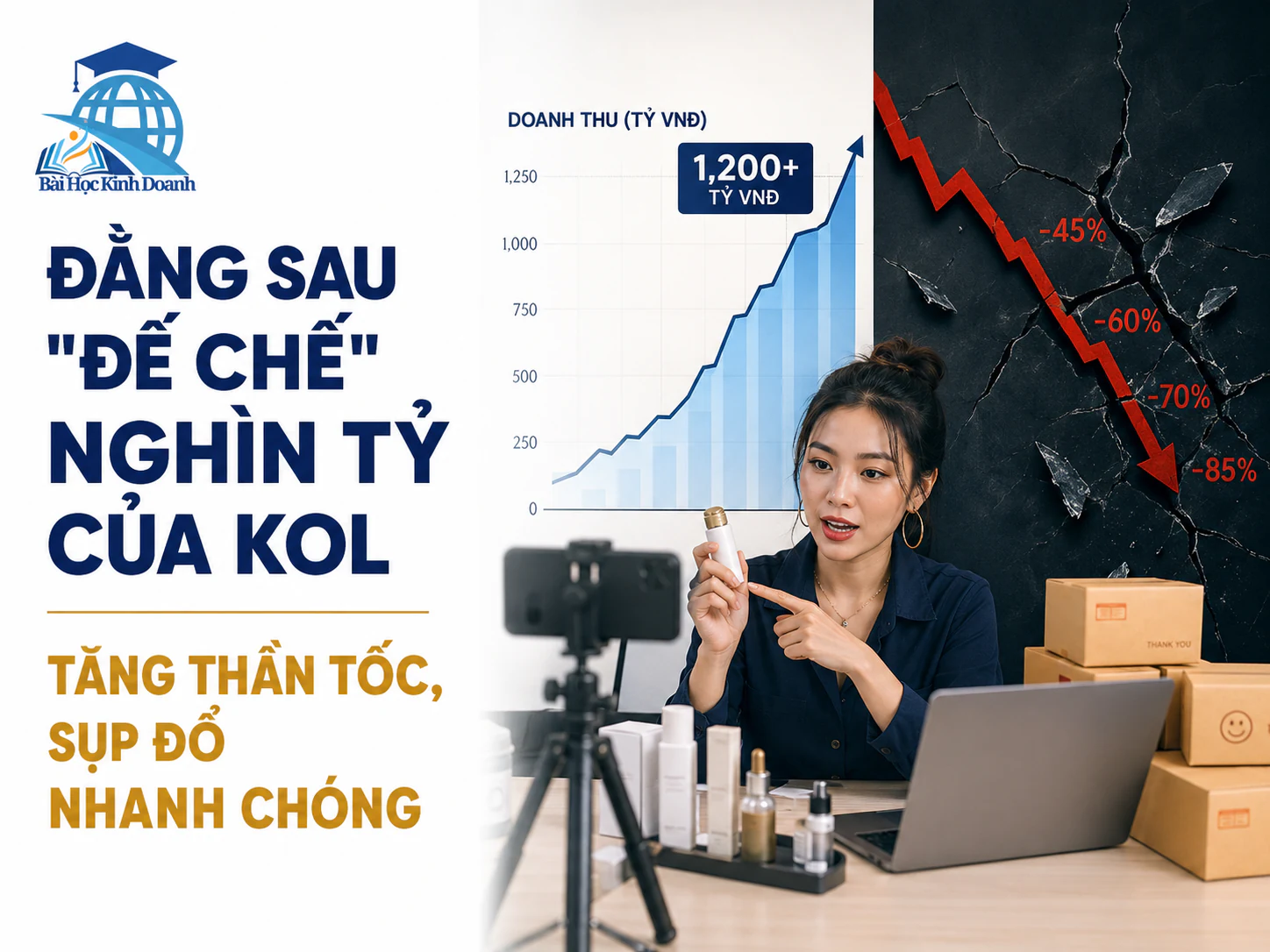
KOLs can turn attention into revenue at a speed traditional businesses struggle to match. Followers, content, livestreams, and trust can take a product from idea to thousands of orders quickly. But sales often outpace product, legal, financial, and after-sales capabilities. When a business is tightly tied to one face, one channel, and one growth surge, any deviation can spread from the product to personal reputation and back to weaken the entire system.
Why can a KOL brand grow unusually quickly?
Ordinary businesses take a long journey to become known, considered, and trusted. KOLs start differently: they already have attention, a community, and interaction history. When launching a product, the brand can reach the right audience without building a channel from zero.
Livestreams and short-form content also compress the purchase journey into one session. Viewers hear the story, see usage, read feedback, receive an offer, and transact on the platform. This speed can suggest a growth formula has been found, when only the ability to activate demand has been demonstrated.
Influence therefore acts as a distribution multiplier. It can create revenue before demand forecasting, supplier management, quality controls, customer care, and reporting systems are complete. Risk accumulates in the gap between sales speed and organizational maturity.
Large revenue does not mean a healthy business
Livestream sales figures easily become the only metric. But gross revenue does not show what remains after goods costs, platform fees, affiliate commissions, advertising, vouchers, shipping, returns, staffing, and complaint-handling costs.
A campaign can generate many orders while straining cash if factories need advance payments, deep inventory is purchased, or refunds are slow. A popular product can also lose money if returns, support, and acquisition costs rise faster than margins.
The right question is therefore not how much a KOL sells in one session, but how much real contribution each order generates, how much working capital it needs, and which post-sale obligations remain. Without answers, speed merely makes problems grow faster.
Four breaking points often hidden during rapid growth
The first is the product. Demand generation can outpace control of ingredients, formulas, production batches, and disclosed information. When launch speed becomes the overriding priority, testing and verification are easily treated as obstacles.
The second is operations. Thousands of simultaneous orders bring warehouse, packing, delivery, service, and return errors. Customer experience can deteriorate just as the brand is most visible.
The third is governance. Power concentrated in the influencer makes it hard for teams to challenge sales messages, stock plans, or partnerships. The final point is finance: revenue rises, but cash, receivables, payables, and inventory are not tracked at the same pace.
When brand and personal reputation become inseparable
KOL brands benefit as buyers transfer trust in a person to a product. But trust flows both ways. A product incident can damage personal credibility; a personal crisis can cause customers to question the entire product range.
Traditional businesses can spread their image across products, spokespeople, and channels. KOL businesses often concentrate every touchpoint on one face. This creates strong communications efficiency and a single point of failure.
A crisis therefore does not diminish in a straight line. When trust reverses, old content, customer feedback, partners, and platforms can amplify the problem together. Sales fall not only from fewer viewers but also as proof, refunds, legal handling, and relationship-repair costs rise.
A dangerous illusion: Controlling content means controlling the business
KOLs are often excellent at understanding audiences, testing messages, and optimizing conversion. But running a livestream differs from managing supply chains, finance, legal matters, and teams. When these roles blend, content success can create the impression that every other decision is right too.
A sustainable organization needs data that can challenge its founder. Profit reports must be able to reject high-revenue loss-making campaigns. Quality teams must be able to delay sales. Customer service must feed complaints into product decisions rather than handle them only at the end.
This does not weaken a KOL’s power. It protects their greatest asset from decisions obscured by speed and confidence.
To build a lasting empire, move from selling to building systems
The first step is to separate three layers of value: personal influence, product strength, and organizational capability. They can support one another but must be measured separately. If a product sells only while the KOL appears continuously, the brand cannot yet stand independently.
The second is controls before, during, and after campaigns. Before selling, have documentation, evidence, forecasts, and risk scenarios. During selling, monitor profit, stock, feedback, and error rates at sufficiently short intervals. Afterward, turn return, complaint, and repurchase data into product decisions.
The third is investing in assets that do not disappear when algorithms change: consent-based customer data, capable teams, supplier relationships, quality procedures, after-sales systems, and a brand story extending beyond one individual.
Seven questions for KOLs who want to become founders
Would customers still choose the product if my name were absent from the sales page? What is each order’s contribution after every cost? How many days of falling revenue can the business withstand? Who can stop sales when quality or documentation is inadequate?
What are returns and complaints telling us that communications do not? If the main channel is restricted, how else can the business reach customers? And if the founder does not appear for three months, can the team keep operating?
These questions do not diminish growth ambition. They distinguish a large sales campaign from a business that can survive long term. A real empire is measured not by peak revenue, but by protecting customers, cash flow, and trust when growth stops.
- Influence reduces the cost and time of generating demand, but does not replace product-development and business-management capability
- Rapid revenue growth can conceal cash-flow, inventory, quality, legal, and single-person-dependency risks
- A KOL brand is sustainable only when personal trust becomes trust in its products, team, and systems
Influence is a distribution advantage, not an exemption from governance. The faster a KOL-led business grows, the earlier it must establish product verification, cash-flow discipline, independent decision rights, and operations that work without the founder’s appearance. If all value rests in one face, the business does not yet own a sustainable brand.
Suggested actions
Sources and updates
Original analysis by Thu Thi from a marketing and e-commerce perspective, updated September 2, 2026. The featured image is illustrative. Figures shown in it are not used as factual data, and the article does not attribute wrongdoing to any specific individual or business.
Last updated: 2 Sept 2026
Thu Thi
Digital Marketing & E-commerce StrategistChia sẻ góc nhìn chiến lược và kinh nghiệm thực tiễn về Digital Marketing, thương mại điện tử, thương hiệu và tăng trưởng, từ những bài toán thực tế trong quá trình đồng hành cùng doanh nghiệp.
View author profile