As shopping habits change and customers move toward modern channels, many traditional Ho Chi Minh City markets face a new challenge: competing is difficult if they only sell goods. But turning the market into a place to explore, experience culture, and take home products with stories opens a different opportunity.
Finding a new customer group for longstanding markets
Weak purchasing demand and numerous closed or transferred stalls are putting considerable pressure on traditional markets. In response, longstanding markets such as Bình Tây, Tân Định, and Bến Thành are starting to target a different customer group: domestic and international tourists.
According to Tuổi Trẻ’s September 29, 2026 report, market managers are implementing measures ranging from distinctive product development and improved trading practices to connections with tour operators and additional experiential activities.
When a pair of clogs becomes a reason to visit a market
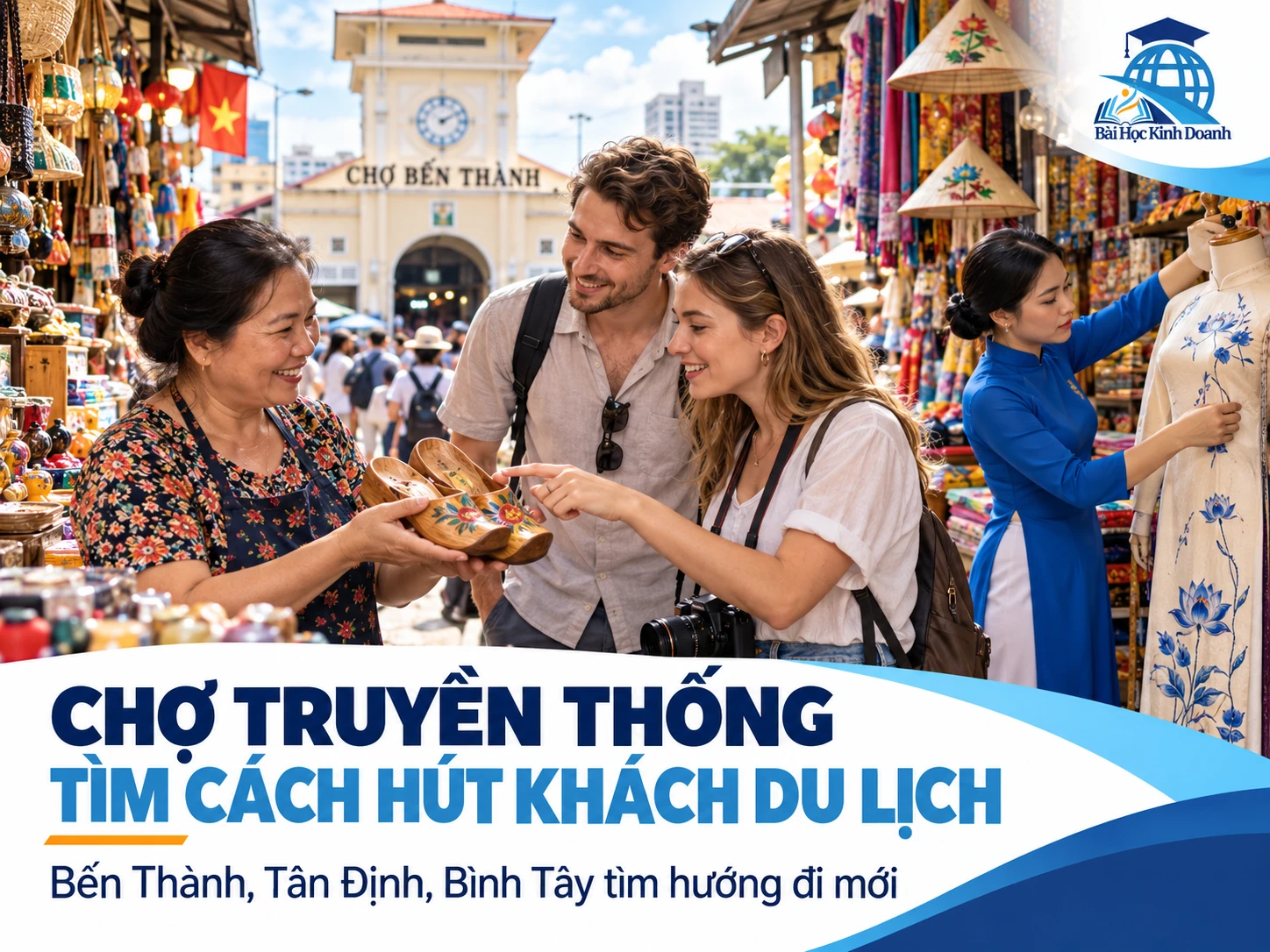
One notable example is Tân Định Market. Built in 1926, the market offers not only commerce but also architectural and historical value. Recently, fashion tailoring, áo dài services, and particularly on-site wooden clog-making have attracted many foreign visitors.
According to observations cited by Tuổi Trẻ, clogs at some stalls commonly cost around VND 100,000–350,000 per pair. On busy days, one stall may serve fifty to sixty customers, many buying several pairs at once.
This is not an isolated phenomenon. VnExpress previously reported that social media videos of clog-making experiences at Tân Định increased foreign visitor numbers at some shops by around 30–50%.
The notable point is that customers do not simply choose a ready-made pair. They watch craftspeople work, select a style, try the product, and take home an item linked to their Vietnam experience. The physical product remains a pair of clogs. What is additionally sold is the story.
At Tân Định, fabrics, fashion, and tailoring also draw customers from Malaysia, Indonesia, India, China, and other markets. At some tailoring businesses in Tân Định and Bến Thành markets and the Phạm Văn Hai Market area, foreign visitors account for a large share of service users, particularly for áo dài and áo bà ba.
Bình Tây Market aims to connect commerce with tourism
At Bình Tây Market, the story takes another direction. Alongside its architectural advantages and Chợ Lớn location, the market is gradually adding visitor amenities.
According to Nguyễn Ngọc Quế Phương, Director of the Bình Tây Ward Public Service Provision Center, the market has introduced international payments and experiences such as lantern- and mooncake-making, and is preparing technology allowing visitors to scan QR codes for market information. Management also wants stronger connections with tour operators as it develops a combined commerce-and-tourism model in the coming years.
For vendors, the change also appears in packaging. Some sellers of sweets, cashews, coffee, and candied products have proactively prepared more attractive packaging, appropriate quantities, and convenient formats for visitors to take home as gifts.
This seemingly small detail reflects an important shift: from selling what you have to designing products that fit a new customer group’s needs.
Bến Thành considers the nighttime economy
Bến Thành Market faces a more specific challenge: according to management information quoted by the press, foreign visitors account for over 80% of customers, but numbers are declining. A management representative said they are considering a nighttime food area combining dining with artistic and cultural performances.
At Tân Định, meanwhile, management plans improvements around the market, development of a food area, stronger links with Tân Định Church, more souvenirs, and continued improvement in trading practices.
According to Lê Quang Thiện, Deputy Director of the Tân Định Ward Public Service Provision Center, tourist visits have grown around 10–15% annually in recent years and could rise about 20% in 2026. This is a projection reported in the press, not a full-year result.
The challenge is no longer simply selling more goods
More broadly, these developments show traditional markets facing a structural change. If consumers only need a shirt, a box of cakes, or a household item, they have many options through e-commerce platforms, social media, convenience stores, and malls. Markets struggle to regain an advantage merely by selling the same item.
But e-commerce cannot fully replace stepping into a nearly century-old market, watching a craftsperson make clogs before your eyes, choosing fabric and having an áo dài tailored on site, tasting local food, or hearing a neighborhood’s history. This is the space traditional markets can use.
Rather than competing directly with online convenience, markets can compete through what online channels struggle to copy: spaces, people, culture, crafts, and on-site experiences.
Read nextRead next: Give customers a clear enough reason to choose youThe Bài Học Kinh Doanh perspective
The story of Ho Chi Minh City’s markets suggests a notable lesson for many traditional business models. When customer behavior changes, the problem is sometimes not a disappearance of demand for the old product. What needs to change is its packaging, experience, and story.
A once-ordinary pair of wooden clogs can become a tourism product when customers select it and witness its completion. A familiar tailoring service can become a cultural experience for international visitors. An old market can become a destination when architecture, food, and history are connected into a sufficiently appealing journey.
However, this transformation cannot depend solely on individual vendors. Plans involving improvements to spaces, transport, nighttime activities, tourism products, or tours require coordination among multiple authorities.
Dr. Dương Đức Minh, Deputy Director of the Ho Chi Minh City Institute for Economic and Tourism Development Research, also notes that unappealing products and unclear standards constrain promotion and connections with tour companies.
Reviving markets may therefore be about more than bringing large numbers of people back to shop. The greater challenge is creating a compelling reason to visit, stay longer, spend, and ultimately share the experience with others.
Read nextApply next: Five ways to increase order value- Wooden clogs, made-to-measure áo dài, and crafts can become tourism experiences rather than only merchandise.
- Bình Tây, Tân Định, and Bến Thành are seeking ways to connect commerce with culture, food, and tour operators.
- Market visits need to translate into time spent experiencing, spending, and recommendations; trust and service quality are foundational.
When customer behavior changes, what needs to change may be how a product is packaged, experienced, and described. A traditional model can find new vitality in hard-to-copy values: spaces, people, culture, and craftsmanship.
Suggested actions
Sources and updates
Editorial references: Tuổi Trẻ, Vietnam.vn, and VnExpress, updated July–September 2026. Prices, visitor figures, and expected growth reflect selected stalls or management information quoted by the press, not the whole market. Illustration supplied by the contributor.

Bài Học Kinh Doanh Editorial Team
Editorial Team | Bài Học Kinh DoanhBan Biên tập Bài Học Kinh Doanh tổng hợp và biên tập các nội dung về kinh doanh, thị trường, quản trị, công nghệ và khởi nghiệp, với mục tiêu giúp người đọc hiểu rõ vấn đề, nhìn thấy bài học phía sau dữ kiện và có thêm cơ sở cho các quyết định thực tế.
View author profile