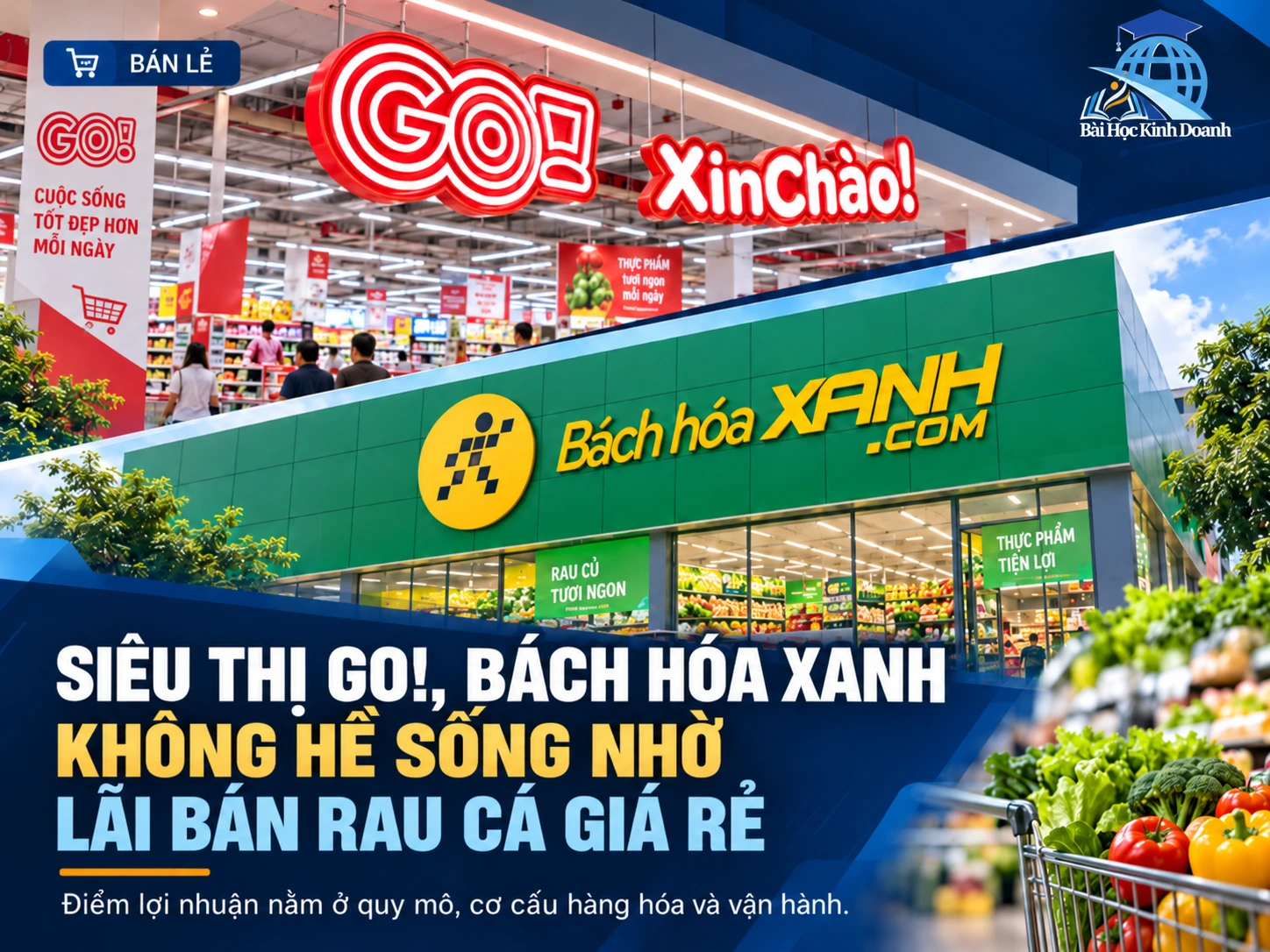
Low prices on a few items cannot explain a whole chain’s profit. Look at gross profit across the basket, shrinkage, store costs, supply capabilities and capital turnover. There is no basis to conclude that fresh food generates no profit, or that GO! and Bách Hóa Xanh have identical income structures.
Shelf prices for vegetables and fish do not tell the whole profit story
Discounted vegetables, promotional meat or rice priced close to the market may make shoppers wonder: where does a supermarket earn its profit? The answer requires examining the entire basket, sales speed, shrinkage and operating costs behind the shelves.
The image’s statement that these chains “do not live off profits from cheap vegetables and fish” is a provocative framing, but should not be read as a conclusion that GO! or Bách Hóa Xanh earns no profit from fresh food. Without detailed category data, individual product-group profits cannot be established. A more rigorous view is that retail profit cannot be explained solely by prices of a few memorable products.
This analysis uses some 2025 disclosures as reference points alongside Bài Học Kinh Doanh’s operational framework. The mechanisms below help explain retail models; they do not assert that both companies apply every mechanism identically.
1. Large revenue can coexist with relatively thin profit
According to VnExpress on February 10, 2026, citing MWG’s CEO at an investor meeting, Bách Hóa Xanh recorded nearly VND 46,900 billion in revenue and VND 710 billion in profit for 2025. The report also noted restructuring of the fast-moving consumer goods assortment and improved fresh-food quality.
Dividing 710 by 46,900 gives approximately 1.5%. This is merely a ratio of two figures cited by the press, not the margin of a vegetable counter, fish counter or individual store. Even so, it shows why small changes in costs, shrinkage or basket mix can matter across chain-wide revenue.
Central Retail’s 2025 results release, published March 2, 2026, describes a multi-category, multi-format business including retail and commercial property. It reports opening two more GO! Malls and renovating two major locations in Vietnam in 2025. This is context for understanding the model, not sufficient data to identify GO! Vietnam’s primary profit source.
2. Distinguish product, store and chain-wide profit
At product level, gross profit is net revenue remaining after cost of goods sold. Selling above purchase cost does not mean the business has net profit, since rent, staff, refrigeration, transport, technology and many other expenses still need covering.
At store level, managers need to know whether contribution after direct expenses covers the cost of maintaining the outlet. At chain level, results also include management, shared infrastructure, financing costs and taxes within the reporting scope. One store’s positive contribution does not establish company-wide profitability.
Keep classifications consistent when tracking management metrics. If shrinkage or logistics is already included in cost of goods sold, do not deduct it again later. Different recognition methods can mean two figures both called “profit margin” are not directly comparable.
3. Vegetables and fish drive purchase frequency, but still need economic viability
Daily food needs can bring customers back regularly. When a store serves meal needs well, the visit also creates opportunities to buy suitable seasonings, milk, cleaning or household goods. This is basket economics, not a claim that every add-on item has a high margin.
Prices of memorable items can affect whether customers perceive a store as expensive or inexpensive. Retail analysis therefore needs to assess some products both for attracting customers and for direct contribution. Competitive prices do not mean below-cost sales, and vegetables and fish cannot automatically be treated as loss leaders.
If a promotional product attracts shoppers, measure whether they buy additional items, total basket contribution and whether they return after the offer. A busy campaign with small baskets, high shrinkage or no repeat purchases can improve revenue while weakening profit.
4. Scale creates advantages when paired with good forecasting and distribution
A large network can aggregate demand, organize stable purchasing and spread system costs across more units. Suppliers may also benefit from planning production and deliveries against clear orders. Scale’s value therefore includes coordination, not just purchase-price negotiation.
Ordering more is beneficial only when goods sell at the right pace. For fresh food, buying cheaply then discarding some inventory can eliminate the original advantage. Additional stores can also increase delivery distances, warehouse costs and control difficulty if the network expands without geographic focus.
Operationally, track existing-store revenue, new-store maturity, delivery costs and shrinkage by area. Store counts indicate coverage; the quality of each outlet shows whether that coverage creates value.
5. Some profit is preserved by reducing spoilage and stockouts
Fresh food involves balancing two risks: overbuying creates surplus, while underbuying loses sales and disappoints customers. Cutting inventory at all costs can make reports look good while frequently missing items customers need. Keeping shelves permanently full can instead increase disposal costs.
The answer lies in forecasting by store, weekday and promotion schedule; checking quality on receipt; appropriate storage; adjusting orders; and handling goods approaching the end of their selling window. Each stage helps protect the margin created during purchasing.
An entirely hypothetical store has net revenue of VND 1 billion a month. If shrinkage costs as a percentage of revenue fall from 3% to 2%, costs decline by VND 10 million, all else equal. This is not data from GO! or Bách Hóa Xanh. It shows how operational improvements can create value without raising selling prices.
6. Basket mix and store productivity determine what remains
A store often serves several needs: everyday items, convenience products, supplementary purchases and occasion-based goods. Optimize the fit between assortment, prices, availability and local demand. Filling shelves with high-margin products that few people buy does not necessarily produce more profit.
Read transaction count, basket value and contribution after related costs together. Deep discounts can increase revenue while reducing money retained per purchase. Conversely, placing commonly used complementary products together can improve basket value without widespread promotions.
When revenue rises on the same premises without a proportionate staffing increase, some costs spread over more transactions. This effect has limits: beyond a certain volume, the store needs more staff, checkouts or storage capacity. Do not treat all costs as fixed in growth planning.
7. Read GO! and Bách Hóa Xanh according to their own models
For GO! Mall, distinguish hypermarket operations from the shopping-mall component, which may include tenants and related services. Central Retail reports sales revenue and gross profit from sales and rentals at group level. These consolidated indicators do not disclose the profit share of individual GO! locations in Vietnam.
Bách Hóa Xanh is discussed as a chain of food and essential-goods stores. Evaluation should focus on outlet productivity, assortment, supply chain and costs of that model. There is no basis to use Central Retail’s rental revenue to conclude that Bách Hóa Xanh earns money the same way.
Similarly, contractual discounts, promotional support and supplier services must be understood through actual terms and accounting treatment. They cannot all be added up as “secret profit,” nor can display fees be declared the main source of survival without sufficiently detailed disclosures.
8. Fast collections benefit cash flow; they do not create profit by themselves
Retail generally collects payment at the transaction, while supplier payment timing depends on contracts. If goods sell quickly and terms are suitable, the business can reduce capital committed to an inventory cycle. This is a cash-timing advantage, not a transformation of payment obligations into revenue or profit.
Extending payables is not a free solution. A business can lose early-payment discounts, weaken supplier relationships or face pressure when sales slow and bills fall due. Track inventory, payables and actual cash together, rather than only one moment’s account balance.
For small operators, the practical lesson is to record cash-in dates, payment deadlines and unsold stock. A store profitable on paper may still lack funds for the next purchase if capital is tied up in slow-moving products.
9. What small shops can learn immediately
There is no need to copy a large chain’s scale to apply this thinking. Start with the most frequently sold groups: which products bring customers back, produce good contribution, tie up capital and require frequent markdowns or disposal?
Next, examine baskets rather than individual products alone. If a competitively priced item leads to relevant additional purchases and regular returns, measure that benefit. If it only attracts a one-off bargain hunt, adjust the approach before increasing the budget.
Finally, put growth alongside operational quality. Low prices can win an initial visit; consistent quality, availability, convenience and controlled costs create the conditions for sustainability. The question is not only “How much does this item earn?” but also “After the full cycle of buying, selling, serving and collecting, what does the business actually retain?”
- Distinguish product gross profit, store contribution and company-wide profit.
- Scale helps only when forecasting, inventory, distribution and store productivity are controlled.
- Cash flow, rental income and supplier support must be read within the correct scope, rather than assumed to be the main profit source.
To understand a retail model, follow the full lifecycle of goods and baskets: purchasing, storage, selling, service and collection. Shelf prices are the visible part; the ability to retain profit depends on the quality of the entire system.
Suggested actions
Sources and updates
Bài Học Kinh Doanh’s analysis draws on 2025 information cited by VnExpress from MWG leadership on February 10, 2026 and official Central Retail disclosures. Approximately 1.5% is calculated from the reported VND 710 billion profit and nearly VND 46,900 billion revenue, not individual product margins. The VND 1 billion monthly store-revenue example is hypothetical. Central Retail’s consolidated figures are not used to infer GO! Vietnam’s profit structure. Operating mechanisms discussed are an analytical framework, not assumed specific policies of either chain. The cover is illustrative; the claim on it is clarified at the start of the article.
Last updated: 26 Sept 2026
Bài Học Kinh Doanh Editorial Team
Editorial Team | Bài Học Kinh DoanhBan Biên tập Bài Học Kinh Doanh tổng hợp và biên tập các nội dung về kinh doanh, thị trường, quản trị, công nghệ và khởi nghiệp, với mục tiêu giúp người đọc hiểu rõ vấn đề, nhìn thấy bài học phía sau dữ kiện và có thêm cơ sở cho các quyết định thực tế.
View author profile