Buying another 11% can change a shareholder’s position more than the figure suggests. For Highlands Coffee, the transaction raises three questions: how much is control worth, why does the seller still want a substantial stake, and how far can chain growth translate into sustainable cash flow?
1. The transaction is an additional equity purchase in the entity behind the chain
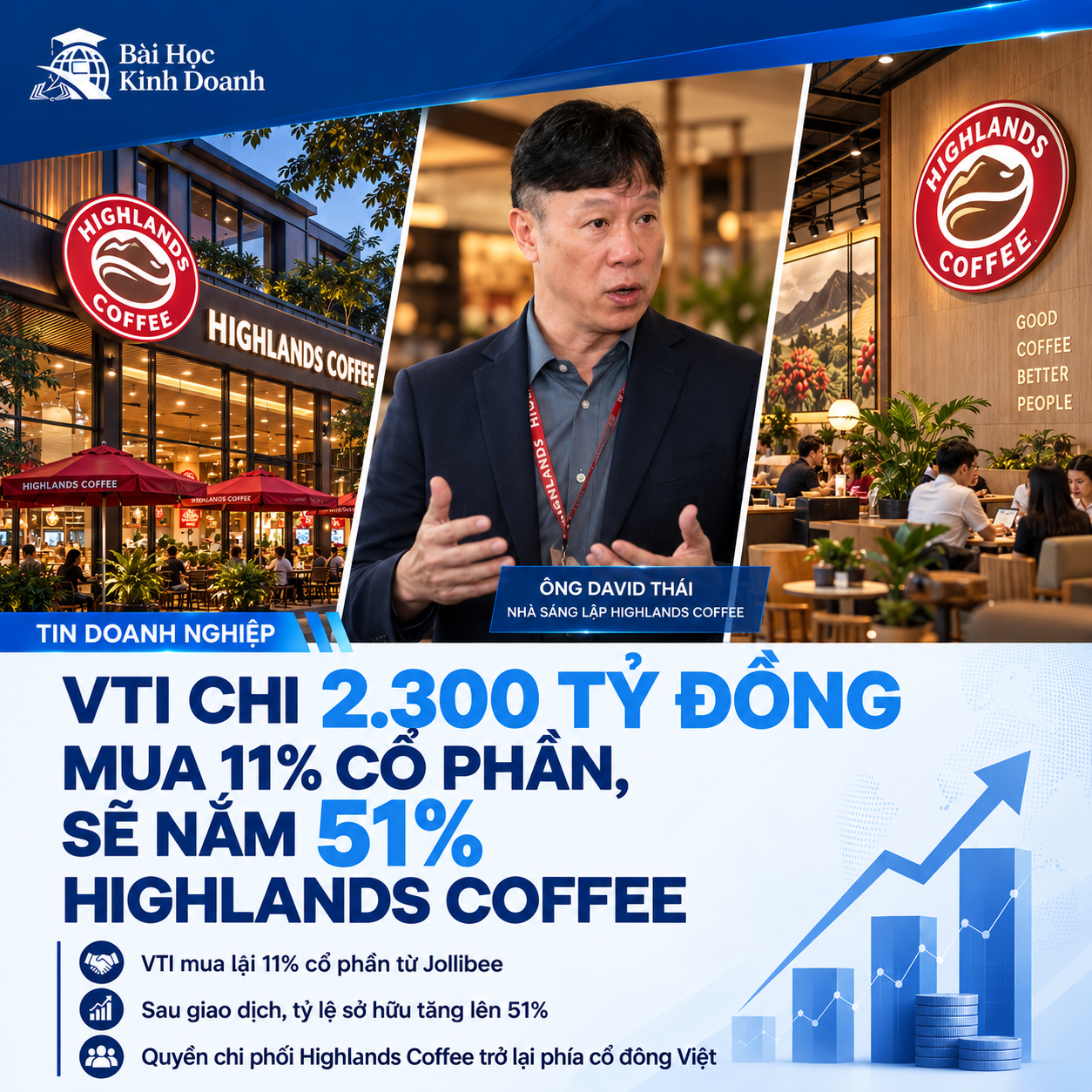
According to Jollibee’s September 23, 2026 announcement, JSF Investments signed an agreement to sell 11% of Highlands Coffee’s Vietnam operations through SF Vũng Tàu to VTI. The price is VND 2.3 trillion, approximately USD 88 million, subject to adjustments. Completion remains conditional.
This is a transfer between shareholders. Payment goes to the seller under the agreement and does not automatically become Highlands’ budget for opening cafés, investing in factories, or upgrading its app.
Two stories must therefore be separated: VTI increases its ownership, and Highlands raises additional operating capital. They may be strategically related, but involve different cash flows. Nor should the corporate buyer VTI be equated with the founder personally paying the entire amount.
2. From 40% to 51%: The change lies in governance position
Tuổi Trẻ cites transaction information showing VTI moving from 40% to 51% and Jollibee from 60% to 49%. This change occurs after completion, making VTI the controlling shareholder.
According to Jollibee, the group retains board representation and minority-shareholder protections. Control should therefore not be understood as unilateral power over every issue.
BHKD perspective: ownership percentage reveals part of the power structure; appointments, budget decisions, fundraising, and dispute resolution also depend on applicable agreements. Without all documents, specific VTI rights cannot be asserted beyond disclosed information.
For founders, the lesson is to negotiate governance rights alongside ownership percentages. Two investments with the same percentage may create very different influence if voting rights and protections differ.
3. Reading the valuation: Equity price is not the brand’s standalone value
Jollibee states an implied equity valuation of around USD 800 million. Payment follows agreed terms after completion, with a capped upward adjustment mechanism. The announcement lacks enough detail to calculate the final amount paid.
BHKD’s illustrative calculation: VND 2.3 trillion divided by 11% implies approximately VND 20.909 trillion for 100% of equity before adjustments. This is an extrapolation from the stated price, not an independent valuation report. Differences on conversion to USD may result from exchange rates and rounding.
The entire figure should not be called the price of Highlands’ logo or brand. Equity buyers consider profitability, assets, obligations, and business prospects. The brand is an important part of that capability.
Equity value must also be distinguished from enterprise value. Meaningful comparisons with EBITDA require consistent treatment of debt, cash, lease obligations, and operating scope. Dividing equity price directly by EBITDA and comparing it with another business may lead to incorrect conclusions.
The additional purchase also takes the buyer past the control threshold, giving the transaction strategic value. However, that alone does not establish that a particular control premium was paid without comparison data.
4. Why does Jollibee sell part of its stake while the chain is growing?
Jollibee says proceeds are expected to support debt reduction, reinvestment, and shareholder interests. It retains 49% to participate in further growth while establishing a reference price for its investment.
BHKD perspective: sellers consider more than whether a business is performing well or poorly. They also consider where capital is tied up, how much other opportunities need, and whether retaining control still suits the overall portfolio.
A partial sale can generate liquidity while retaining long-term economic exposure. Conversely, retaining a large stake means the seller continues to bear risk if performance falls short.
The story should therefore be read as a capital-allocation decision. There is no basis yet to characterize it as Jollibee fleeing, Highlands struggling, or one party winning outright. Both sides may pursue different objectives through the same agreement.
5. What is VTI buying beyond future profit participation?
Strategically, the buyer may value greater influence over the chain’s direction. A shareholder familiar with the market and involved in operations may have its own view on products, locations, expansion speed, or customer experience. This is analysis of possible motivations, not information about internal plans.
Greater discretion also brings capital responsibilities. Expensive transaction financing creates different payback pressure from long-term funding. This article lacks sufficient public information to identify VTI’s financing structure.
What merits observation is the balance between the buyer’s payment obligations and the operating business’s reinvestment needs. It cannot be assumed that Highlands’ cash flow will fund the share purchase, nor that the chain must increase prices to finance it.
6. Chain growth: Look at both new and existing outlets
In Q2 2026 results, Jollibee reported Highlands Coffee system-wide sales growth of 46.7% year on year. Tuổi Trẻ cites 11.5% same-store sales growth in Vietnam. These measures have different scopes, so subtracting one from the other cannot precisely determine new-store contributions.
System-wide sales reflect network sales scale. Same-store sales show performance across comparable outlets. Both are useful, but neither directly answers how much profit or cash each unit of sales generates.
A chain can grow sales through more outlets, higher prices, additional products, or more customer visits. Growth quality varies with the main drivers and the cost of producing that growth.
Deeper evaluation requires average sales, store margins, rent, payback periods, and repeat-customer rates. A busy opening does not establish effectiveness over the entire lease term.
A dense network risks outlets serving the same customer base. Rising total revenue alongside falling revenue per outlet warrants closer scrutiny of new openings. This is a general chain-model risk, not a conclusion that Highlands currently faces it.
7. Marketing perspective: Large valuations need protection through small experiences
In its April 2026 update, Jollibee described most Highlands digital sales as coming from third-party platforms, while its own app was increasing its share. It also emphasized operating discipline and store-level efficiency. This is company-disclosed information.
For a beverage chain, delivery platforms reach additional demand, while owned channels can improve customer understanding and membership programs. However, moving customers to a proprietary app does not automatically create profit if promotional and operating costs are too high.
Measure profit after costs by channel, repurchase frequency, and genuinely incremental orders. An order moved from the counter to the app may improve data but does not necessarily increase total sales.
At brand level, a shareholder change is only a communications moment. Lasting value still comes from drink quality, service speed, spaces, convenience, and handling customer problems. Small experiences repeated daily protect the large expectations on the negotiating table.
8. An IPO is notable context, not a certain outcome
Tuổi Trẻ says Highlands has been considered for an independent Vietnamese IPO targeting Q1 2027. This is a stated plan, not confirmation of approval or certainty that the offering will occur on schedule.
A transaction between existing shareholders may create a price reference. But an IPO price also depends on updated performance, market conditions, shares offered, and investor demand. This transaction’s valuation cannot be treated as a guaranteed future price.
If a subsequent fundraising round issues new shares, existing shareholders may be diluted unless they participate proportionately. The post-transaction ownership percentages therefore describe only one point in the capital structure.
For founders preparing to raise funds, the lesson is to build multiple ownership and cash scenarios. After each funding step, know who retains which rights, how much cash the business receives, and which growth goals are genuinely financed.
9. Three scenarios to monitor after the transaction
Favorable scenario: operational quality and demand are maintained, new outlets perform well, and the two shareholders cooperate effectively. Both control and the retained stake may then benefit from stronger business capability.
Slower-growth scenario: sales still rise, but property, staffing, ingredient, or acquisition costs rise faster. Profit and cash flow matter more than network size in this case.
Less favorable capital-market scenario: the IPO is delayed or valuation expectations need adjustment. The business must sustain growth with suitable resources rather than stake its entire plan on one funding round.
These are analytical scenarios, not probability forecasts. Signals worth watching include completion announcements, same-store results, new-outlet performance, and official information on subsequent capital structure.
10. Business lesson: Negotiate more than price—design the journey afterward
The Highlands transaction suggests a lesson beyond buying or selling: a business may need a capital partner during expansion, then revise ownership as objectives change. What matters is whether collaboration creates value beyond each party’s equity stake.
For chain builders, prove one good outlet before scaling. For fundraisers, understand which rights you sell and which capabilities you gain. For acquirers, check whether future cash flows can support the expectations embedded in today’s price.
Retaining decision power is a milestone. Turning that power into better products, more loyal customers, and a sustainably operated business is the work that continues long after signing.
- VTI plans to raise ownership from 40% to 51%; Jollibee will retain 49% after completion.
- VND 2.3 trillion is the planned transfer price, subject to adjustments; it is not new funding automatically flowing into the chain.
- Equity valuation, operational performance, and governance rights need separate consideration.
Founders need to design both capital structure and operating capability. Control matters when accompanied by cash generation, partner governance, and consistent quality during expansion.
Suggested actions
Sources and updates
Edited September 27, 2026 from Jollibee Group’s announcement and listed sources. Analysis, calculations, and hypothetical scenarios are by Bài Học Kinh Doanh. The designed image was supplied by the contributor for illustration, not as a photograph of a signing ceremony. Transaction status follows the agreement announcement and is not treated as completed.
Last updated: 27 Sept 2026
Bài Học Kinh Doanh Editorial Team
Editorial Team | Bài Học Kinh DoanhBan Biên tập Bài Học Kinh Doanh tổng hợp và biên tập các nội dung về kinh doanh, thị trường, quản trị, công nghệ và khởi nghiệp, với mục tiêu giúp người đọc hiểu rõ vấn đề, nhìn thấy bài học phía sau dữ kiện và có thêm cơ sở cho các quyết định thực tế.
View author profile