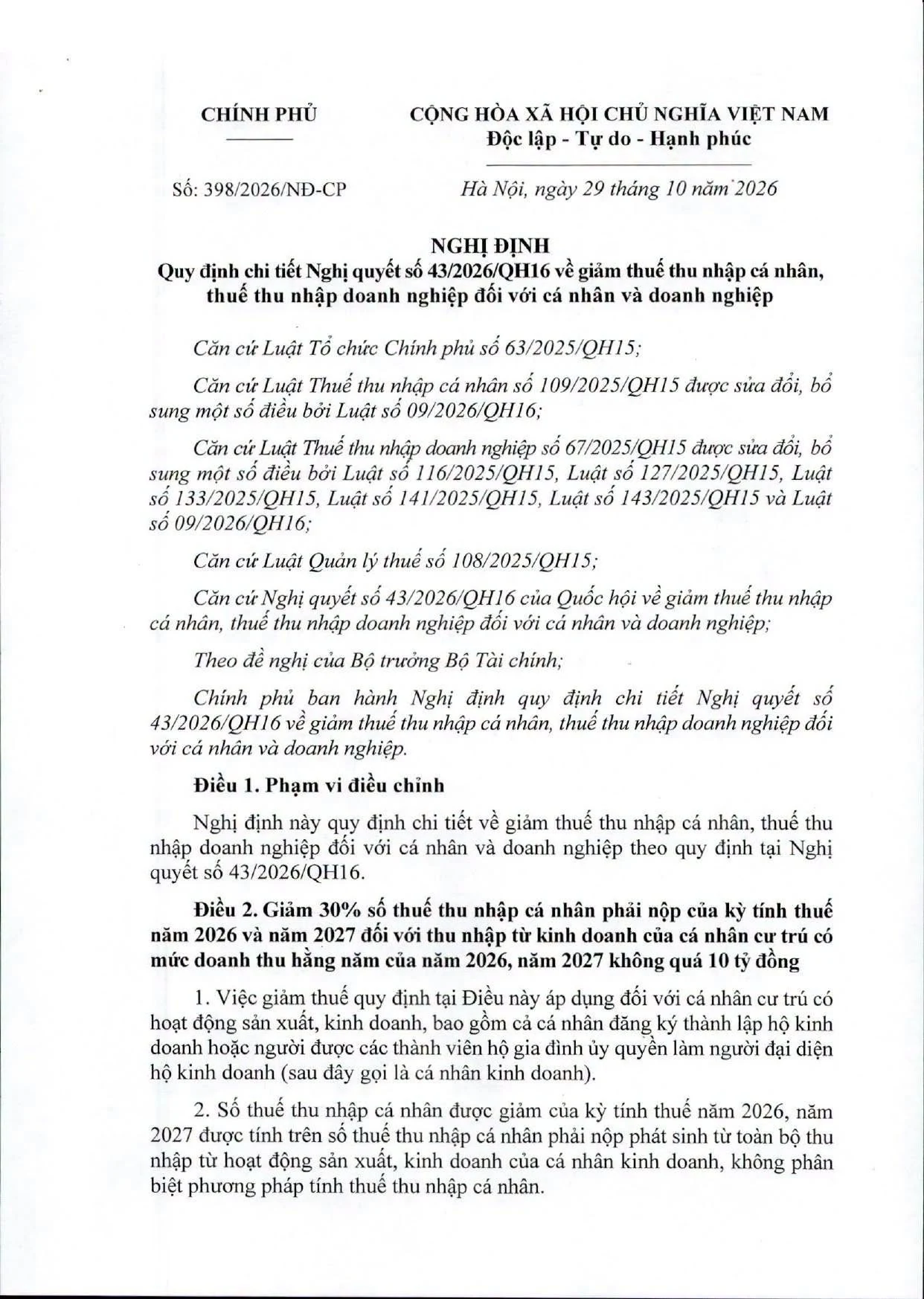

A sector-specific review of revenue and records for 30% tax relief, with illustrative examples, reconciliation worksheets, PIT/CIT filing routes and ceiling monitoring.
1. Build a project register before calculating relief
Assign each project an ID linked to its contracting taxpayer, client, initial value, amendments, acceptance milestones and invoices. Contractors also selling materials or design should distinguish activities so the accountant can apply the appropriate revenue and tax treatment.
The annual VND 10 billion ceiling is not a per-project allowance. A company must aggregate relevant revenue even when each individual project is below the ceiling. Household businesses use the PIT route; companies review CIT under Decree 398.
2. Distinguish advances, acceptance and warranty retention
Maintain separate columns for advances, accepted work, invoices, receivables and warranty retention. These are different views of the contract, not five revenue streams to add together. Determine recognition from applicable rules and actual records before assessing relief.
Unpaid or retained amounts are not automatically excluded from revenue, and cash received is not automatically all current-year revenue. Multi-year contracts require supported allocation under applicable rules, not arbitrary payment or acceptance timing to preserve eligibility.
3. Review year-end variations and calculate an example
Illustration: a company has VND 9.3 billion of properly determined eligibility revenue. A VND 0.8 billion variation belongs to the year only after recognition is reviewed. If all belongs to that year, revenue becomes VND 10.1 billion and eligibility must be reassessed. Contract face value or cash collection alone is insufficient.
Separate calculation: another company has VND 6.2 billion of eligible revenue and CIT before this relief, after any other incentives, of VND 120 million. If all conditions hold, relief is VND 36 million and tax remaining is VND 84 million. Do not multiply revenue by 30%; the tax amount is assumed, not a sector tax rate.
4. Choose the correct filing route and retain receipts
Business individuals review Form 01 with the applicable return. Withholding or filing agents use Form 02 for their responsibilities. Companies self-determine relief when making quarterly CIT payments; the individual’s Form 01 is not a company CIT-relief form.
Suggested workflow: close the period, assess eligibility, calculate tax before relief, calculate relief, check official forms, file through the applicable electronic tax channel, and retain signed files, acknowledgements and payment evidence. These are working steps, not universal portal button names. Review amendment rules for missed relief rather than arbitrarily deducting it from a later payment.
5. Monitor the ceiling and prepare the evidence pack
Individuals exceeding VND 10 billion actual annual revenue reverse relief using Form 03 with the filing for the threshold-crossing period. The specified late-payment exclusion ends at that period’s filing deadline. Companies pay the shortfall and follow Article 24(3) of Decree 252/2026/ND-CP rather than assuming the individual rule applies.
Assign someone to update monthly cumulative revenue and outstanding orders or contracts, with a review date. Retain source records, calculations and reconciliations for independent review. The following is a recommended internal evidence pack, not a universal mandatory attachment list.
| Item | Action |
|---|---|
| Contracts and amendments | Reconcile value, scope and contracting parties. |
| Acceptance, handover and invoices | Match project IDs without double-counting advances. |
| Receivables and retention | Explain differences between revenue and receipts. |
- Assess revenue within the taxpayer’s proper scope, not per transaction.
- Reconcile receipts, revenue and collections for others before applying relief.
- Reduce eligible tax without assuming one tax rate for the sector.
Correct tax relief starts with reconcilable revenue records, not a convenient number.
Suggested actions
Frequently asked questions
Does each project get a separate ceiling?
No. Aggregate the taxpayer’s revenue under the applicable rules rather than applying a separate ceiling to each contract.
Series: 30% tax relief: sector guides
- 30% PIT and CIT reduction: guidance for revenue up to VND 10 billion
- Retail and online sales: a guide to the 30% tax reduction in 2026–2027
- Restaurants and cafés: 30% tax relief and multi-location revenue reconciliation
- Services and contract manufacturing: 30% tax relief from contract review to finalization
- Construction and interiors: 30% tax relief and project revenue review
- Transport and logistics: 30% tax relief and freight, COD and collection reconciliation
- Salons and spas: 30% tax relief and package and prepaid-card revenue
- Wholesale and distribution: 30% tax relief and sales reconciliation
- Accommodation and hotels: 30% tax relief, OTA payouts and deposits
- Marketing and digital services: 30% tax relief and advertising budgets
Updated 1 November 2026. Based on Articles 2 and 3 of Decree 398/2026/ND-CP published by the Government Portal. Numerical examples are illustrative and checklists organize records; apply the rules to the actual records and tax method.
Last updated: 1 Nov 2026
Bài Học Kinh Doanh Editorial Team
Editorial Team | Bài Học Kinh DoanhBan Biên tập Bài Học Kinh Doanh tổng hợp và biên tập các nội dung về kinh doanh, thị trường, quản trị, công nghệ và khởi nghiệp, với mục tiêu giúp người đọc hiểu rõ vấn đề, nhìn thấy bài học phía sau dữ kiện và có thêm cơ sở cho các quyết định thực tế.
View author profile