The US-before-Vietnam information reflects trademark filing order, not a confirmed order of outlet openings. From BHKD's perspective, these preparations may represent an option for market expansion; the value of the coffee cart model must still be tested through positioning, operations and the economics of each outlet. This is an analysis of strategic possibilities, not a statement about Trung Nguyên's internal plans.
1. US before Vietnam: read trademark milestones correctly
Speed Coffee has attracted attention within the Trung Nguyên Legend ecosystem associated with entrepreneur Đặng Lê Nguyên Vũ. To examine the model's strategy more deeply, first distinguish preparing a brand name from putting an outlet into operation.
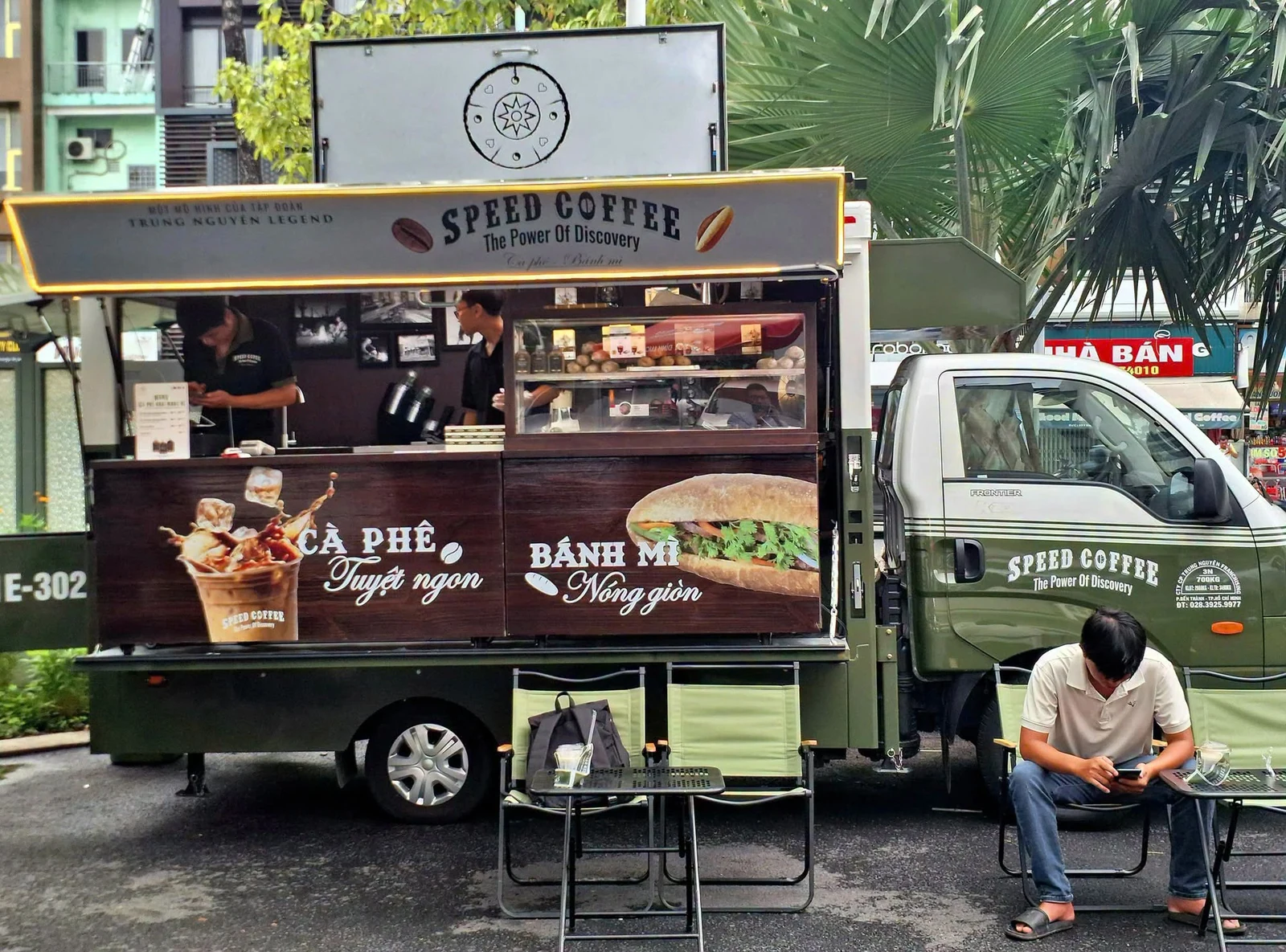
According to Justia data, US application 99403687 was filed on September 19, 2025 by Công ty TNHH Đầu tư và Phát triển thương hiệu Trung Nguyên Legend. CafeF reported on October 6, 2026 that the Vietnam application was filed on June 10, 2026 and the cart model was trialed in Ho Chi Minh City in August.
USPTO allows filing on an intent-to-use basis, meaning a trademark can be prepared before commercial use. It also explains that a Notice of Allowance is not completed registration; the application must still meet relevant use and procedural requirements. A legal milestone therefore does not establish that a store is operating.
What merits analysis is the sequence of preparation, not a confirmed US opening story. Public information identifies a branding option; it does not establish precisely who decided, the internal objective or when an overseas outlet will open.
Separating evidence from interpretation has practical value when reading business stories. Confusing a trademark application with a successful operating model can lead readers to overestimate how thoroughly a strategy has been tested.
Filing order may also reflect protection plans or the preparation timeline in each market. More information is needed to distinguish these possibilities. BHKD therefore treats the US-before-Vietnam milestone as a starting point for strategic questions, not the sole evidence of a secret intention.
| Milestone | Cited fact | Does not establish on its own |
|---|---|---|
| 19 Sept 2025 | US application; Justia, number 99403687 | An outlet already exists in the US |
| 10 Jun 2026 | Vietnam application; according to CafeF | Registration has been granted |
| 30 Jun 2026 | Notice of Allowance; cited by Furm and CafeF | Trademark registration is complete |
| August 2026 | Ho Chi Minh City trial carts; reported by CafeF | The financial performance of the entire network |

2. One ecosystem, multiple consumption occasions
BHKD's perspective: one reasonable interpretation is that Trung Nguyên is adding ways to reach customers by consumption occasion. Someone may sit in a café to meet a partner in the afternoon but need a quick drink and meal on the way to work in the morning. These may be two needs of the same person, not necessarily separate income segments.
According to CafeF's August 21, 2026 report, the trial cart offered drinks at around VND 25,000–33,000 and coffee-and-bánh mì combos at around VND 50,000–55,000. These are prices at the time of reporting, not a current price list. They suggest a service promise: familiar products, a streamlined process and convenience in a single purchase.
Layering formats can expand coverage without requiring every outlet to have the same physical setup. But a brand name is only the beginning. Customers must understand differences through menus, experience, prices and reasons to choose. If distinctions are unclear, the new format may take revenue from existing outlets rather than create additional demand.
Conversely, if it serves an occasion the existing café network struggles to reach, a cart may add purchase frequency. To assess this possibility, you need to know where new customers come from, which alternative they replace and how many return after trying it. A busy opening day does not answer those questions.
This analysis does not confirm that the company has announced Speed Coffee as a particular strategic tier. It provides a framework for understanding outlet-format differences and identifying the data needed before judging their impact on the ecosystem.

3. A small cart does not mean a small system behind it
BHKD's perspective: a cart may reduce some fixed-space requirements while shifting management toward outlet organization and supply chains. Ingredients must arrive on time, quality must stay consistent, and drink preparation and food assembly must coordinate in limited space. A compact-looking outlet may still depend on complex logistics.
Bánh mì alongside coffee adds a meal occasion and another operating rhythm. Drinks and food may have different preparation times, storage conditions and peak periods. If bánh mì preparation becomes a bottleneck, the quick-purchase promise can fail even when coffee is ready on time.
Measuring the time needed to make one cup is therefore insufficient. Track the entire period from order receipt to complete handover, rework, discarded ingredients and service performance when customers arrive together. A focused menu may aid standardization but must still be tested during real shifts.
A system scales when another operator can deliver equivalent quality. If an outlet works only with an exceptional employee or close managerial supervision, adding carts may multiply dependency. Documentation, training, checks and authority to handle exceptions need to keep pace with expansion.
These are variables to investigate, not confirmed descriptions of Speed Coffee's internal processes. The lesson for business owners is not to treat a small footprint as proof that the entire model is simple or inexpensive.
Read nextDesign a one-page SOP for an outlet that can be handed over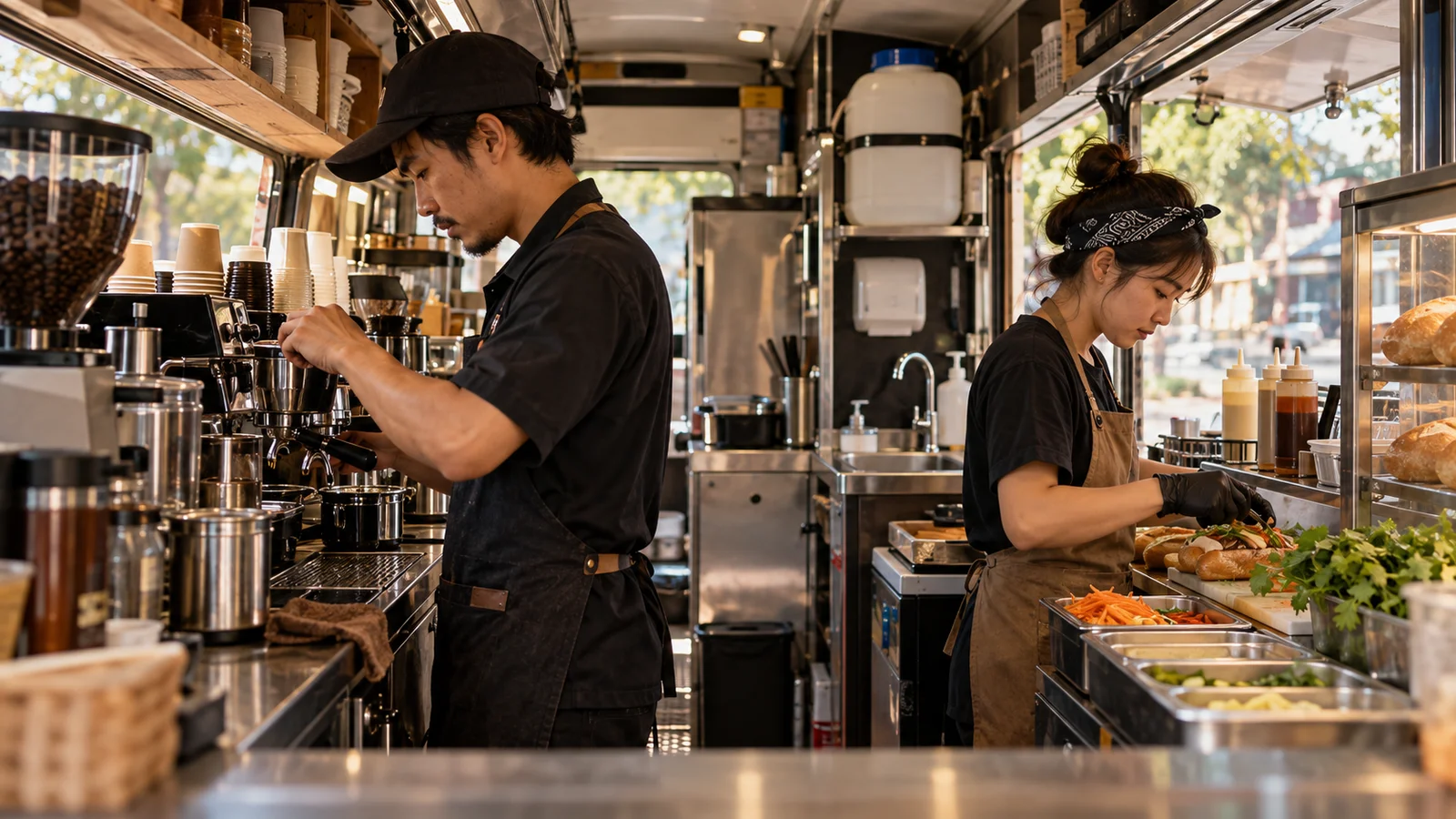
4. Each outlet's economics provide the decisive test
There is currently insufficient public data to calculate an actual Speed Coffee cart's profit. BHKD uses the entirely hypothetical example below to explain how to assess a model. These figures are not Trung Nguyên's costs, expenses or revenue.
Assume average revenue per order of VND 30,000, variable cost per order of VND 12,000 and daily fixed operating costs of VND 900,000. Contribution per order is VND 18,000. Under the standard break-even formula described by SBA, dividing fixed costs by contribution per order yields 50 orders per day.
Hypothetical variable costs include order-dependent items such as ingredients, packaging and transaction fees. Hypothetical fixed operating costs cover staff, the selling location and basic daily logistics. The table excludes cart-investment depreciation, financing costs, taxes and shared support costs, so its result is not net profit.
For a menu with multiple items, averages are meaningful only when the order mix is relatively stable. If combo share rises, both average revenue and variable cost may change. Adding food does not automatically ensure higher profit: examine incremental contribution, service effort and food waste.
Capacity also limits the calculation. If an outlet takes many orders but queues grow, errors increase or staff work overtime, actual costs may exceed the assumptions. A low spreadsheet break-even point is useful only when service capacity and demand fit it.
| Orders | Revenue | Variable costs | Result after VND 900,000 in fixed operating costs |
|---|---|---|---|
| 35 | VND 1,050,000 | VND 420,000 | −VND 270,000 |
| 50 | VND 1,500,000 | VND 600,000 | VND 0 |
| 80 | VND 2,400,000 | VND 960,000 | VND 540,000 |

5. A pilot outlet can be a place to learn about the market
BHKD's perspective: a potential benefit of a small format is a bounded testing scope. A company can observe demand by location and time before choosing how to expand. This is a hypothesis about experimentation's value, not a claim that Trung Nguyên is running a specific research program.
Data should connect foot traffic to orders: how many people can be reached, how many buy, what is the order value, and how many return? Each layer answers a different question. High traffic with low purchases may relate to the offer or accessibility; many first-time buyers with few return visits require investigation of experience and perceived value.
An outlet busy at peak time is not necessarily efficient all day. Compare locations over equivalent observation periods, weather conditions, promotional activity and menu mix. Ignoring these factors can confuse the appeal of a special occasion with steady demand.
Mobility does not remove the need for consistency. Regular customers must know where and when to find the outlet; operators need suitable location conditions. Moving a site should balance learning about the market with the ability to establish buying habits.
An experiment creates knowledge only when it has a question, data and a subsequent decision. If every opening starts again with intuition, a company may expand quickly without accumulating a reusable location-selection standard.
| Question | Data to examine |
|---|---|
| Does demand recur? | Orders by hour and day, and returning customers |
| Is service consistent? | Time to complete orders, errors and overload |
| Does the outlet generate sufficient contribution? | Revenue, item mix, costs and waste |
| Does the new outlet add to the market? | Customer sources and impact on existing outlets |

6. Preparing for the US and operating in the US are two different challenges
Trung Nguyên Legend has announced its café network's US presence, including Trung Nguyên E-Coffee. This context shows the company has operating experience in a market outside Vietnam. It does not establish that Speed Coffee operates in the US or will follow the same expansion approach.
BHKD's perspective: early filing may prepare for a future option, allowing brand work to proceed before the company decides its operating investment. However, the record alone cannot establish that the US is the first testing market, that an opening is imminent, or that the model has been proven.
If introduced in the US, Vietnam-based assumptions would need retesting. In what circumstances do customers buy coffee and bánh mì? Do they understand the products, what prices will they accept, and what explanation do they need? Staffing, logistics and outlet conditions must also be determined locally, rather than simply converting dong into US dollars.
Product identity can differentiate the offer, but using it must be accessible. For unfamiliar customers, introductions, menus, selection guidance and packaging can matter. A name aids recognition; a convenient purchase and consistent quality provide the basis for the next one.
International strategy should therefore be read on two levels: readiness to prepare the brand and ability to organize a service model with suitable economics. Preparing the first has value but does not replace evidence for the second.
Read nextVietnamese products going global: understand the market and product use
7. Lessons for founders: examine model design, not just the cart's appearance
The useful lesson is how a brand name connects to a model choice and a testing process. A company may prepare early, keep several growth options open and trial a customer-access approach. But success needs demand, service-quality and cost data, not merely an appealing vision story.
Small-business founders should not treat a group's scale or reputation as evidence that a similar model will suit them. Identify the advantage you actually possess: products, ingredients, customers, operating skills or location. Then choose a trial small enough to observe and clear enough to support a decision.
Before expanding, write down what must be true for the model to work. Customers must need a quick purchase in the chosen hours; the team must serve without increasing errors; contribution must cover costs; customers must have a reason to return. Each assumption needs a test, a resource limit and a review date.
When results fall short, distinguish the wrong location, wrong offer, wrong process and wrong cost structure. All four can produce low revenue but require different remedies. Adding outlets before understanding why the first is ineffective can make the problem harder to control.
BHKD has no basis to call this a secret confirmed by the founder. What we can do is put public facts into an evidence-oriented framework: trademark preparation, consumption-occasion selection, operational testing and outlet-level assessment. The strategy's appeal lies in how these pieces work together; results must still be demonstrated in practice.
| Assumption | Suggested test |
|---|---|
| Customers need the product in the intended occasion | Observe, discuss and test offers by time slot |
| The service promise can be delivered | Measure complete-order handover time and errors during real shifts |
| Outlet economics are strong enough | Record revenue, item mix, costs and waste |
| Someone else can operate it | Test a supervised handover within an appropriate scope |
| Customers have a reason to return | Track repeat purchases and investigate the experience |

- Trademark filing, procedural approval and actual trading are different milestones.
- A compact format still needs supply, quality and outlet management systems.
- The number of carts or product trials is insufficient to establish profitability or scalability.
A brand can prepare for multiple future possibilities, but an advantage becomes a result only when the model serves customers and generates cash flow at each outlet. The useful lesson is to connect vision with data-driven experiments.
Suggested actions
Frequently asked questions
Did Speed Coffee open US outlets before Vietnam?
The sources cross-checked in this article show the US trademark application preceded the Vietnam application. This does not establish that Speed Coffee opened US outlets before Vietnam.
Does a Notice of Allowance mean trademark registration is complete?
According to USPTO, it is a step allowing the process to continue, but registration is not complete. Intent-to-use applications must still meet relevant requirements; consult the specific record for updated status.
How many orders does a Speed Coffee cart need to break even?
Public cost data is insufficient to calculate this for Speed Coffee. The article's 50 orders per day is hypothetical, assuming VND 30,000 revenue and VND 12,000 variable cost per order plus VND 900,000 fixed operating costs per day; it does not include every cost.
What can a coffee cart model offer beyond sales?
Analytically, it may provide a way to test demand by location, selling hours and menu. This value is verified only when data leads to decisions; it cannot be inferred from the cart format or first-day crowds.
Sources and updates
Edited and cross-checked on October 7, 2026. Vietnam milestones and the trial model are cited from CafeF; US trademark records were cross-checked against public Justia and Furm data. The page-reading tool could not display the detailed TSDR record, so this article does not assert current legal status based on a direct lookup. The explanation of intent-to-use follows USPTO guidance; the context of US presence follows Trung Nguyên Legend announcements. Strategic interpretations are BHKD's analysis, not statements by Đặng Lê Nguyên Vũ. Financial examples are entirely hypothetical; AI images are labeled separately.

Bài Học Kinh Doanh Editorial Team
Editorial Team | Bài Học Kinh DoanhBan Biên tập Bài Học Kinh Doanh tổng hợp và biên tập các nội dung về kinh doanh, thị trường, quản trị, công nghệ và khởi nghiệp, với mục tiêu giúp người đọc hiểu rõ vấn đề, nhìn thấy bài học phía sau dữ kiện và có thêm cơ sở cho các quyết định thực tế.
View author profile